Debt Snowball vs. Avalanche: Which Debt Payoff Method Saves More Money?
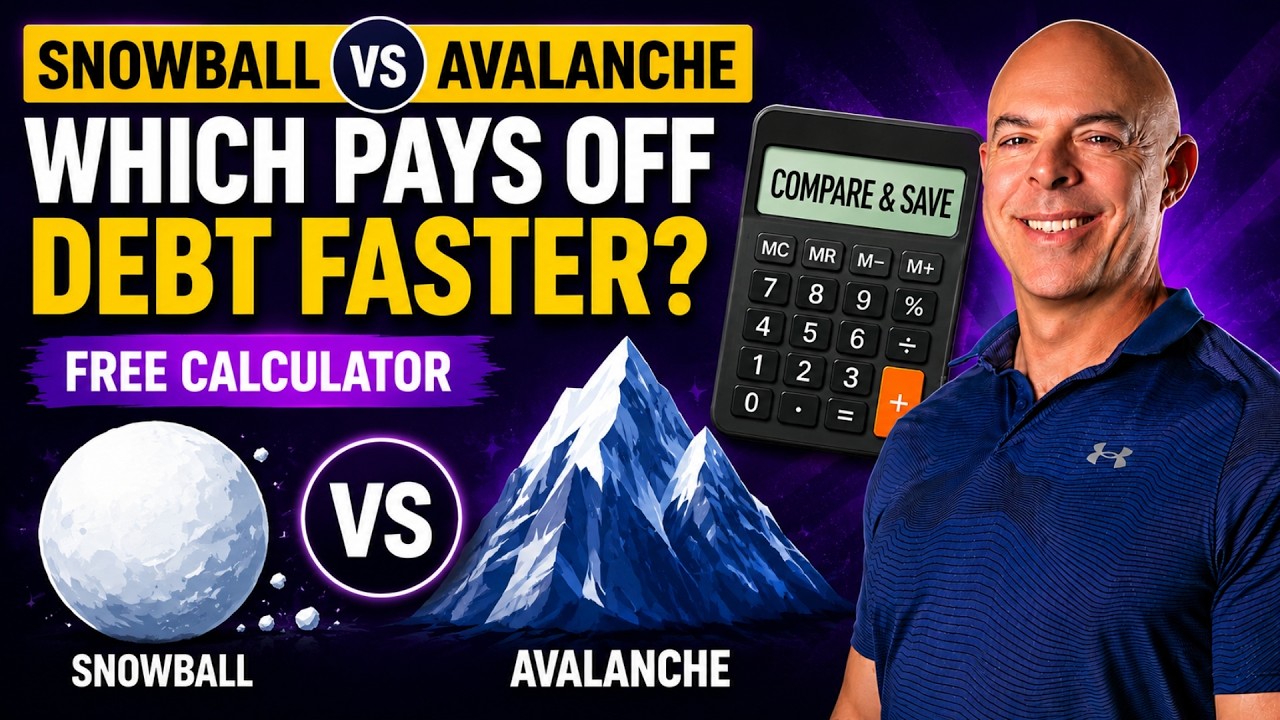
Everybody argues about the debt snowball and the debt avalanche, but almost nobody puts real numbers behind it. In this video I open both calculators side by side, use the exact same three debts in each one, and show where the two methods are identical and where they split apart.
The short version: when you're only paying the minimums, the two methods can land in the same place. The moment you add extra money every month, the math starts to favor one of them.
What you'll learn
- What the debt snowball and debt avalanche actually do, in plain English
- Why both calculators can show the same savings on the same debts
- What changes when you add an extra $400 a month
- How the payment schedule tells you exactly where to send money each month
- Why people still choose the snowball even when the avalanche saves more
The setup: three debts, two calculators
I start on hackyourcreditcards.com and open the Debt Snowball Calculator in one window and the Debt Avalanche Calculator in another. Both come prefilled with the same example: a credit card at $10,000, a personal loan at $14,000, and a car loan at $7,000, each with its own interest rate and monthly payment. That's $31,000 of debt and $1,550 a month in payments.
With just those minimum payments, the results are the same in both tools: about $7,000 in interest over 52 payments if you change nothing, and about 24 months and $2,151 saved once you use either payoff method. Same number in both windows. So at first glance you think, fine, they're identical.
How the two methods order your debts
They aren't identical, and the difference shows up in the payment schedule at the bottom. Every row is a month, and every column is a debt.
The snowball orders your debts smallest balance first. Here that's the $7,000 car. When the car is gone, its $450 payment rolls onto the next debt. The $300 payment becomes $750. When the next one falls, another $800 rolls over and the payment becomes $1,490. That rolling is where the name comes from, and that part is the same in both methods.
The avalanche reorders by interest rate instead. The credit card is at 24%, so it goes first. Then the personal loan at 11%, then the car at 8%. Same rolling behavior, different order.
Where the avalanche wins
To make the difference obvious, I add an extra $400 a month to each calculator. Apples to apples, same debts, same extra money, just a different order.
The snowball says send the extra $400 to the smallest debt: the car payment goes from $450 to $850. Total interest saved: $3,417.
The avalanche says send the extra $400 to the 24% credit card instead: that payment goes from $300 to $700. Total interest saved: $3,797.
Same money, same debts, roughly $380 difference, just from the order. The reason is simple. Killing the highest interest rate first stops the most expensive bleeding first.
So why does anyone use the snowball?
Because it's psychological, and that's not nothing. When you're buried and you think you'll never get out, wiping out one small debt feels great and keeps you going. Mathematically, the avalanche saves more. But the plan you actually stick with beats the plan you abandon.
Using the calculators on your own debts
The example numbers are just placeholders. Delete rows you don't need, add rows you do, name them whatever you want. For each debt you enter the balance, the interest rate, and the monthly payment, then hit calculate. The tool shows your savings, your new payoff timeline, and a month-by-month schedule telling you exactly how much to send to each debt and when to change the amount. In one month a debt hits zero and the schedule shows the money moving to the next one.
Key steps
- List every debt: balance, interest rate, and current monthly payment.
- Enter them into the avalanche calculator and the snowball calculator.
- Run both with minimum payments first so you see your baseline interest and payoff date.
- Add whatever extra you can truly afford each month and run both again.
- Compare the interest saved and the payoff timeline side by side with the avalanche vs. snowball tool.
- Pick the method you'll stick with, then follow the payment schedule row by row.
- Every time a debt dies, roll its payment onto the next one. Don't let it leak into spending.
FAQ
Does the avalanche always save more than the snowball?
Mathematically, paying the highest interest rate first is what saves the most interest. In the example here, with only minimum payments the two methods showed the same $2,151 in savings. Once an extra $400 a month was added, the avalanche saved $3,797 versus the snowball's $3,417. Your own numbers will differ, which is exactly why you run them.
What if I can't add any extra money right now?
You can still use either method, because rolling a finished payment onto the next debt costs you nothing extra. And if you want more room, look at cutting spending temporarily — see how to pay off credit card debt fast by cutting expenses.
Should I pick the snowball for motivation instead?
That's a fair choice. The snowball is popular because knocking out a small debt feels good and keeps you in the game. The avalanche saves more money. Run both in the calculators, look at the real dollar gap, and decide if that gap is worth more to you than the early win. There's also a full guide to building a payoff plan if you're starting from scratch.
The step-by-step written version, with a worked example.