Using an Auto Refinance to Pay Off Credit Card Debt: The Real Math
If you have a car that's worth more than you owe on it, and a credit card charging you something in the neighborhood of 25%, you may be sitting on a move you didn't know you had. Not selling the car. Refinancing it.
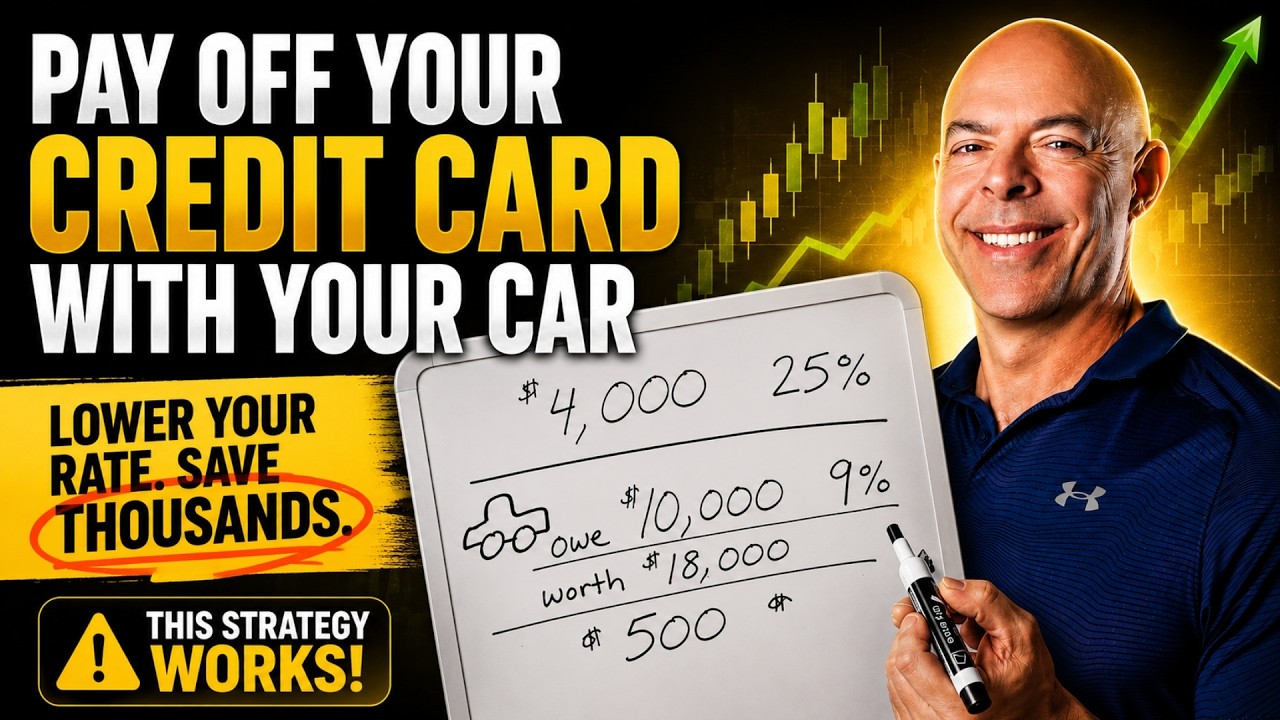
Brian walks through it on video.
The idea is simple: borrow against the car at a low rate, use that money to kill the high-rate card, and end up with the same total debt at a much cheaper interest rate. It's not magic and it's not free — there's a real risk attached, and I'll get to it. But the math is worth understanding before you spend another year sending minimum payments into a 25% APR.
Why interest rate is the whole game
Most people think about debt in terms of total balance. Lenders think about it in terms of rate. A $4,000 balance at 25% and a $4,000 balance at 9% are completely different animals. The first one is costing you roughly $1,000 a year just to exist. The second one costs about $360. Same debt, same you, wildly different price tag.
So anytime you can move a dollar of debt from a high rate to a low rate without changing anything else, you've made money. That's really all a balance transfer is. That's all a cash-out auto refinance is. Different tools, same principle.
What you need for this to work
- Equity in the car. The vehicle needs to be worth more than the loan balance. That usually happens after a couple of years of payments.
- A rate gap. The auto loan rate has to be meaningfully lower than the credit card rate. If they're close, don't bother.
- Stable income. This is the one people skip. More on that below.
- The discipline to not spend the savings. If you pocket the lower payment, the whole thing backfires.
A worked example with simple numbers
Let's use round numbers you can follow.
| Debt | Balance | Rate | Payment |
|---|---|---|---|
| Credit card | $4,000 | 25% | $200 minimum |
| Car loan | $10,000 | 9% | $500 |
| Total | $14,000 | — | $700 |
The car is worth about $18,000. You bought it in the low $20,000s, it depreciated, and you paid the loan down to $10,000. Your $500 payment is high because it was written on the original $25,000 purchase price, not on the $10,000 you owe today.
Option one: refinance just the balance
You call your lender, or a different lender, and refinance the $10,000 that's actually left. Because the balance is much smaller than the original loan, the payment drops — say to $200 a month.
Now you have $300 a month you didn't have before. You keep paying $200 on the car and throw $500 a month at the credit card instead of $200. That $4,000 card at 25% goes from a multi-year slog to gone in under a year.
This version doesn't add a dollar of new debt. It just reroutes cash flow. If the idea of borrowing against your car makes you uncomfortable, stop here — this alone is a big win.
Option two: the cash-out refinance
Here's the version that does more. You ask the lender how much they'll lend against the car. They look at the $18,000 value and say they'll write a loan for $14,000 — not the full value, but well above the $10,000 payoff.
So you take the $14,000 loan at 9%. The lender sends $10,000 to pay off the old car loan. The remaining $4,000 lands in your bank account. You send every dollar of it to the credit card.
Where you stand now:
| Before | After |
|---|---|
| $10,000 car loan at 9% | $14,000 car loan at 9% |
| $4,000 credit card at 25% | $0 credit card |
| $14,000 total | $14,000 total |
| $700/month | Maybe $300/month required |
Read that carefully. The debt didn't go away. You still owe $14,000. What changed is that none of it is at 25% anymore. All of it is at 9%. And your required minimum payment dropped from $700 to something like $300, because a $14,000 loan stretched over a new term costs less per month than an old loan plus a card minimum.
The step that actually gets you out of debt
You were paying $700 a month before. Keep paying $700 a month.
Same money leaving your account, but now 100% of it is attacking one loan at 9% instead of being split between 9% and 25%. Nothing is being eaten alive by the card rate. That $14,000 gets destroyed dramatically faster than it would on the $300 minimum, and you pay a fraction of the interest you would have paid in the original setup.
If instead you take the $400 a month of "savings" and spend it, you've done something worse than nothing: you stretched $14,000 of debt over a longer term and attached your car to money that used to be unsecured. Run both versions through the auto loan early payoff calculator and you'll see the difference immediately.
The risk nobody mentions: secured vs. unsecured
This is the part you must not gloss over.
Credit card debt is unsecured. There's no asset behind it. If you stop paying, the card company can't come take your stuff. They can damage your credit, call you, and eventually take you to court and pursue a judgment — which is genuinely bad — but the debt isn't tied to a specific thing you own.
Auto loan debt is secured by the car. The moment you roll that $4,000 into the auto loan, it stops being unsecured and becomes debt you could lose your vehicle over.
So the honest trade is: lower interest rate, lower payment, higher stakes. If your income is stable and you're committed to the payoff plan, that trade usually makes sense. If your job is shaky or your budget has no margin, think hard — losing the car you drive to work is a much bigger problem than a collections letter.
How this compares to other ways to move debt
0% balance transfer
A 0% intro card can beat a 9% auto loan outright, and it keeps the debt unsecured. The catch is the transfer fee, the approval requirements, and the promo window — if you don't clear the balance before it ends, you're back at a high rate. Work the numbers with the balance transfer break-even tool and read through the real math on 0% cards before you assume it's the better option.
Just paying extra
You don't have to refinance anything to make progress. Attacking the highest-rate balance with every extra dollar you can find is the avalanche method, and it works. See snowball vs. avalanche and why paying extra beats minimums. The refinance is a way to create those extra dollars — not a replacement for using them well.
Cutting expenses
The cheapest source of extra payment money is spending less for a while. No lender approval, no risk, no paperwork. It's just harder.
Your checklist
- Look up what your car is worth and what you owe. That's your equity.
- List your credit card balances, rates, and minimums.
- Call your current lender and at least one other and ask two questions: what rate would you refinance me at, and how much would you lend against this car?
- Compare the new rate to your card rate. If the gap isn't real, skip it.
- Decide honestly whether you can handle secured debt.
- If you move forward, send every cash-out dollar to the card the day it hits your account.
- Keep paying the old combined payment. Track it with the Debt-Freedom Tracker.
Bottom line
Moving debt isn't the same as erasing it. Anyone who tells you otherwise is selling something. But moving $4,000 from a 25% card to a 9% auto loan is a real, measurable win — it cuts what that debt costs you by more than half, frees up monthly cash flow, and if you keep paying the same amount you were paying before, it gets you out of debt far sooner.
The two things that make or break it: don't spend the payment savings, and don't ignore the fact that you've put your car behind money that used to be unsecured. Run your own numbers in the free calculators before you call anyone, and if you want a step-by-step plan, start with building a payoff plan that actually works.