How to Use a Car Refinance to Pay Off Credit Card Debt (25% to 9%)
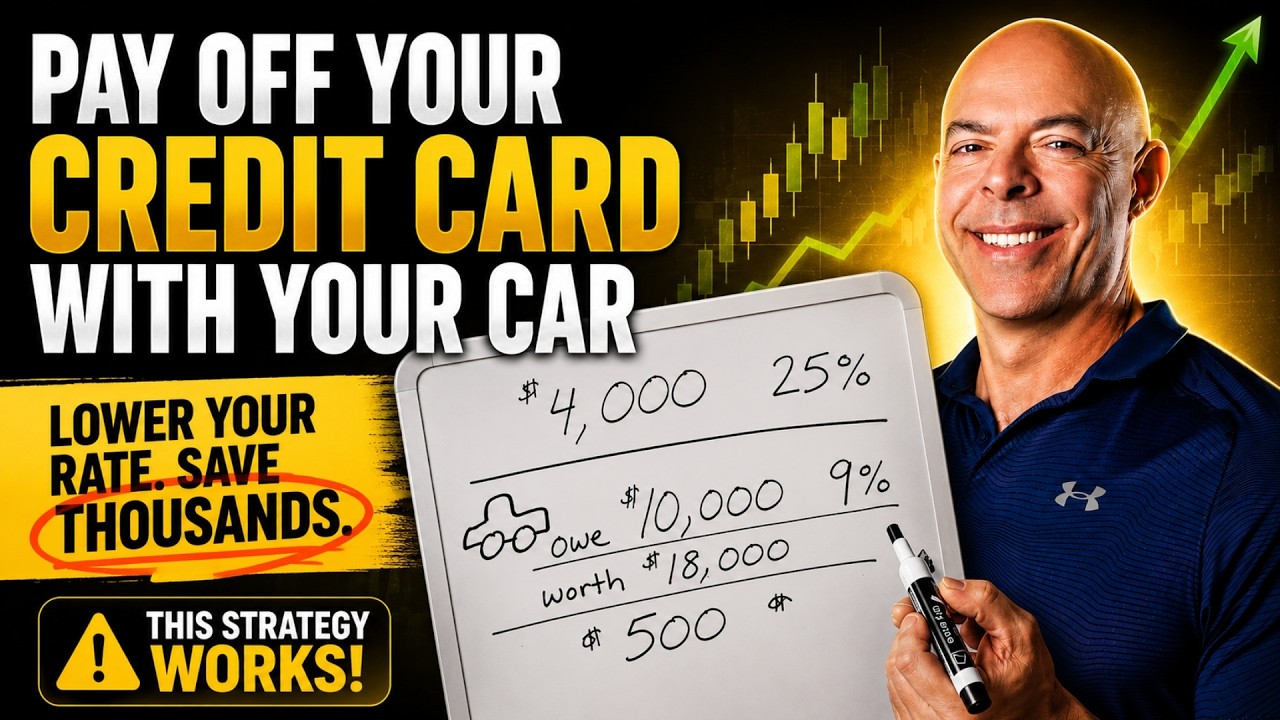
In this video I walk through something I actually did: I refinanced my car for more than I owed on it, took the extra cash, and used it to wipe out a credit card charging 25% interest. The debt didn't disappear — it moved from a 25% rate down to a 9% rate.
This is educational only, not financial advice. But if you've got a car worth more than the loan on it and a credit card eating you alive, the math here is worth understanding — along with the one big risk most people don't think about.
What you'll learn
- How a cash-out auto refinance can replace high-interest credit card debt
- Why refinancing a smaller remaining balance can drop your monthly payment
- The difference between unsecured credit card debt and secured car debt
- Why you should keep paying the old total payment after the refinance
- How moving debt to one lower rate gets it paid off much faster
The setup: two debts, two very different rates
The example I draw out starts with a credit card carrying $4,000 at 25%. Then there's the car: you've been paying on it a while, so there's about $10,000 left on the loan at 9%, and the car itself is worth roughly $18,000 — maybe you bought it in the $20,000s and it depreciated while you paid the loan down.
The key point isn't the exact numbers. It's the gap. One debt is at 25%. The other is at 9%. That gap is the whole opportunity.
Approach one: refinance to free up cash flow
The first thing I ever did was simply call about refinancing that remaining $10,000. My payment was $500 a month, because the original loan was written on something like $25,000. But I only owed $10,000 now. If I refinanced just that balance, the payment might drop to around $200. That's $300 a month freed up — and I'd take that $300 and throw it straight at the credit card.
That alone is a legitimate strategy. Nothing fancy, no extra borrowing.
Approach two: the cash-out refinance
Here's where it got more interesting. When I talked to the lender, they said the car is worth $18,000, so they'd write a loan for $14,000 — not the full value, but more than the $10,000 I needed. So I refinanced at $14,000, also at 9%. They sent $10,000 to pay off the old car loan and deposited the extra $4,000 in my bank account.
I sent that $4,000 straight to the credit card. Gone. The 25% was gone.
What actually happened to the debt
Be honest about this part: the $4,000 didn't vanish. Before, I had $10,000 on the car at 9% plus $4,000 on a card at 25% — $14,000 total. After, I had $14,000 on the car at 9%. Same total debt. All of it now at the lower rate.
And one thing matters a lot: credit card debt is unsecured. They can't take anything from you directly, though they can take you to court and get a judgment. Once that $4,000 is rolled into the car loan, it's secured. Miss payments and you can lose the car. You need to know that going in.
The move that makes it work: don't take the savings
Before, I was paying roughly $500 on the car plus a $200 card minimum — about $700 a month, split between 9% and 25% rates. After the refinance, the new car payment was more like $300. So I kept paying $700 anyway, all of it on one 9% loan.
Same money out of my pocket every month, but none of it feeding a 25% rate. That loan gets crushed far faster. That's the point of the whole exercise. If you take the payment savings and spend them, you've just stretched your debt out longer and put your car on the line for nothing.
Key steps
- Write down what you owe on the car, what the car is worth, and the interest rate.
- Write down your credit card balance, rate, and minimum payment.
- Call your current lender or another company and ask what they'd refinance you for — and at what rate and payment. Run it through the auto loan calculator first.
- Ask whether they'll lend more than the payoff amount based on the car's value.
- If the new rate is meaningfully lower than the card, send the cash-out straight to the card — not to anything else.
- Keep making the old combined payment on the new loan. Check the difference with the auto loan early payoff calculator.
- Understand you've traded unsecured debt for secured debt, and don't miss payments.
FAQ
Does this actually get rid of my debt?
No. It moves it. In my example the total stayed at $14,000 — it just all landed on the 9% loan instead of part of it sitting at 25%. What you gain is a lower interest cost and a lower required payment, which lets the same dollars wipe the balance out much faster. Compare it to just attacking the card directly with the credit card payoff calculator.
What's the biggest risk?
Credit card debt is unsecured. Car debt is secured by the car. Rolling $4,000 of card debt onto your auto loan means that money is now attached to a vehicle you can lose if you stop paying. If your income is shaky, that's a serious trade-off to weigh.
What if my lender won't lend more than I owe?
Then fall back on the first approach: refinance just the remaining balance, drop the payment, and shovel the difference at your highest-rate debt. That's the avalanche idea in action, and you can map it out with the Avalanche Debt Eliminator or the Debt-Freedom Tracker.
The step-by-step written version, with a worked example.