Behind on Your Car Payment? How to Avoid Repossession
Auto loan delinquencies have been climbing, and a car payment is a different kind of debt than a credit card. Miss a credit card payment and you get a fee, a phone call and a mark on your credit. Miss enough car payments and the car itself disappears — and then you can't get to the job that pays for everything else.
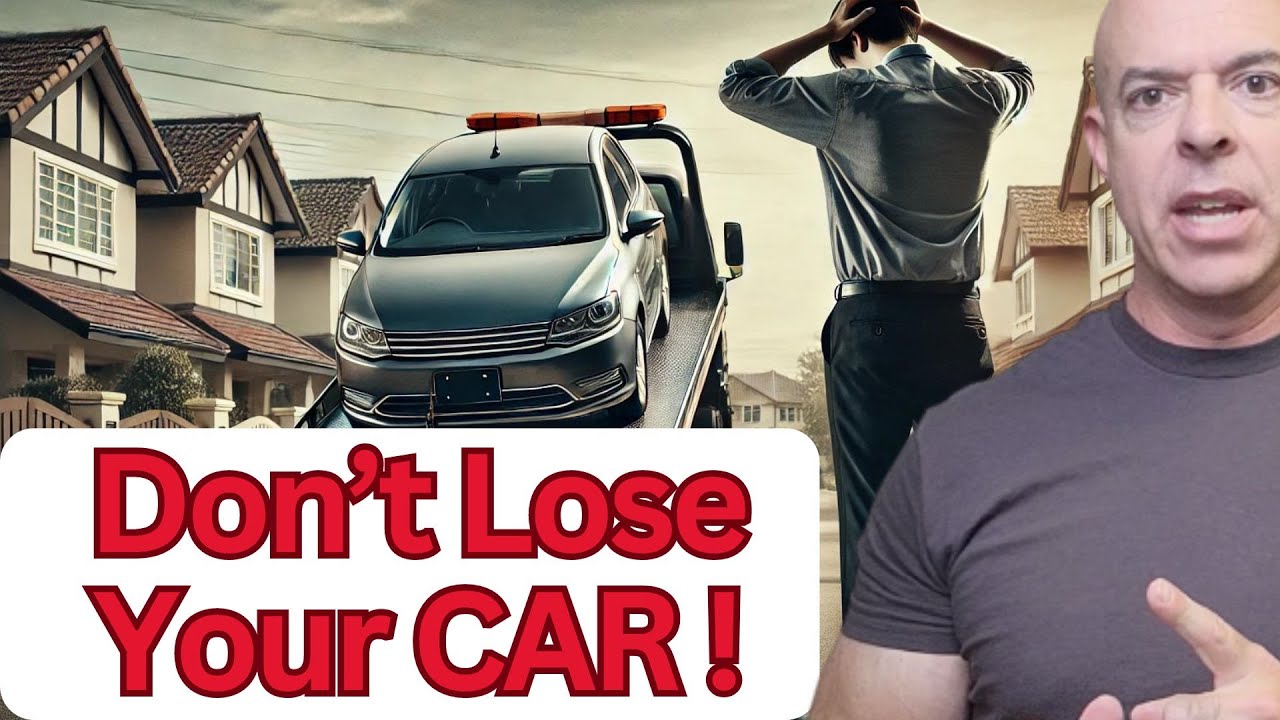
Brian walks through it on video.
I've stood in a driveway staring at an empty spot where my Honda Pilot used to be. In my case it was a bank computer glitch that flagged 500 to 600 accounts across the country and sent faxes to tow companies. I hadn't missed a payment. The bank apologized and paid the fees and I got the car back. But that sick feeling of "both of us work, how do we get anywhere now" is something I don't want you to experience for real.
So here's what to do if you're behind or about to be, in plain order.
Step 1: Figure out exactly where you stand
Before you panic, get the facts on paper:
- How many payments are you actually behind, and by how many days?
- What is your current payoff balance — not the original loan amount?
- What is your interest rate and how many months are left?
- What is the car realistically worth today?
That last one matters. If you owe more than the car is worth, selling your way out isn't simple, and you'll want to read what to do when you're upside down on a car loan. If you have equity, you have options a lot of people don't realize they have.
Step 2: Call the lender before they call you
The worst thing you can do is go quiet. Lenders deal with people who are behind every single day, and the person answering the phone has a script with options on it. You won't get those options if they can't reach you.
Ask what programs exist for your account. Ask whether a due-date change is possible so the payment lands after your paycheck instead of before it. Ask what the actual delinquency timeline looks like for your loan — how far behind you'd have to be before the account moves toward repossession. Write down the date, the name of the person you spoke with and what they told you.
And keep your own payment records. My repossession happened because a computer said I was behind when I wasn't. If a system can be wrong about me, it can be wrong about you, and proof is what fixes it.
Step 3: Free up cash for one month, not forever
Getting current usually doesn't require a permanent lifestyle change. It requires one unusually aggressive month. Pause subscriptions, cook everything, skip anything optional, sell something sitting in the garage. I wrote about this approach in cutting expenses temporarily to kill debt, and the same logic applies to catching up a car loan.
The point isn't austerity. The point is that the car is the single most protected item in your budget right now, because it's the thing that lets you earn.
Step 4: Once you're current, attack the balance
Here's what most people miss. Interest on a car loan is calculated on the total you still owe. Every dollar you knock off the balance early reduces the interest on every month that follows. That's why getting out of the loan faster is the real protection against repossession — the shorter your remaining term, the fewer months you're exposed to a job loss, a medical bill or a bank glitch.
A worked example
Say you borrowed $20,000 at 7% over 60 months. Round numbers: your payment is about $400 a month, and over five years you hand the lender roughly $24,000 — $20,000 of principal and about $4,000 of interest.
Now add $50 a month. You send $450 instead of $400. That extra $50 doesn't sit anywhere; it goes straight to principal. The balance falls faster, so less of each future payment is eaten by interest, so the balance falls faster still. Instead of paying $24,000 you might pay closer to $22,000 or $23,000, and instead of 60 months you might be done in roughly 54. That's six months you're no longer making a car payment, and six fewer months anyone can take the car.
Fifty dollars a month. That's the whole trick.
The one-time payment version
Can't find $50 every month? Use lump sums instead. Say every birthday you get $200 from a relative and you put it on the car. Over five years that's $1,000, dropped in five chunks. Tax refunds, work bonuses, a side gig payout — same idea. The one-time car payments calculator lets you enter multiple dates and amounts so you can see exactly what each one buys you in months and interest.
Step 5: Compare your options with real numbers
Three questions come up constantly, and all three have math answers instead of opinion answers.
Should I pay down the car or save the money?
If you're sitting on $1,000, you can put it in a CD or a treasury and earn a few percent, or you can put it on the car and "earn" the interest you no longer pay. Depending on your rate and how much time is left, the effective return on the car can be dramatically higher than the savings rate — in one example I've walked through, a $1,000 one-time payment worked out to a 39% return. Run both sides. Sometimes the boring debt paydown wins by a mile. See also savings account vs. paying off debt.
Should I borrow to pay down the car?
This is the velocity banking question. Say you're 14 months into a 7% car loan and your bank will give you a 12-month personal loan of $5,000 at 10%. At first glance it's insane — you're paying off cheaper debt with more expensive debt. But the personal loan is a smaller amount over a much shorter time, while the car loan interest is charged on the whole balance for years. Drop the car from $20,000 to $15,000 and suddenly a bigger slice of your unchanged $400 payment goes to principal instead of interest.
Sometimes the numbers work. Sometimes they don't. Never do this on vibes — put your actual figures into the auto loan velocity banking calculator and let it tell you, and read does car loan velocity banking really save money first.
What if this car is just too expensive?
Sometimes the honest answer is that the loan was too big from day one. If you're shopping for a replacement, do not let a dealership move the conversation to "what can you afford every month?" That question is designed to bury the price. The price is what the loan is written on, and the price is what leaves you underwater later. You can take the payment they quote plus the interest rate and work backwards to the price they're actually charging — and it's sometimes above the sticker in the window. The auto loan calculator does that math for you.
Step 6: Build a small buffer so this doesn't repeat
Once you're current and paying extra, start setting aside one car payment. Then two. A buffer of two or three payments turns a scary month into an annoying month. If your income is shaky, preparing for a layoff while carrying debt is worth reading before you need it.
The bottom line
Falling behind on a car payment isn't a character flaw — it's a cash flow problem with a timeline attached. Know your exact numbers, talk to the lender early, buy yourself one aggressive month, then shrink the balance faster than the schedule requires. The fastest way to never lose a car is to stop owing money on it, and small extra amounts get you there sooner than you'd think.
Start with the early payoff calculator, then browse the rest of the free calculators and put your own numbers in. No guessing.