Borrowing Against Assets to Pay Off Debt: The Real Math
There's a strategy the wealthy use that most people never hear explained in plain English: they don't sell their assets to buy things. They borrow against them. The founder of a big company doesn't liquidate stock to pay for a house. The stock keeps growing; the loan gets paid back later.
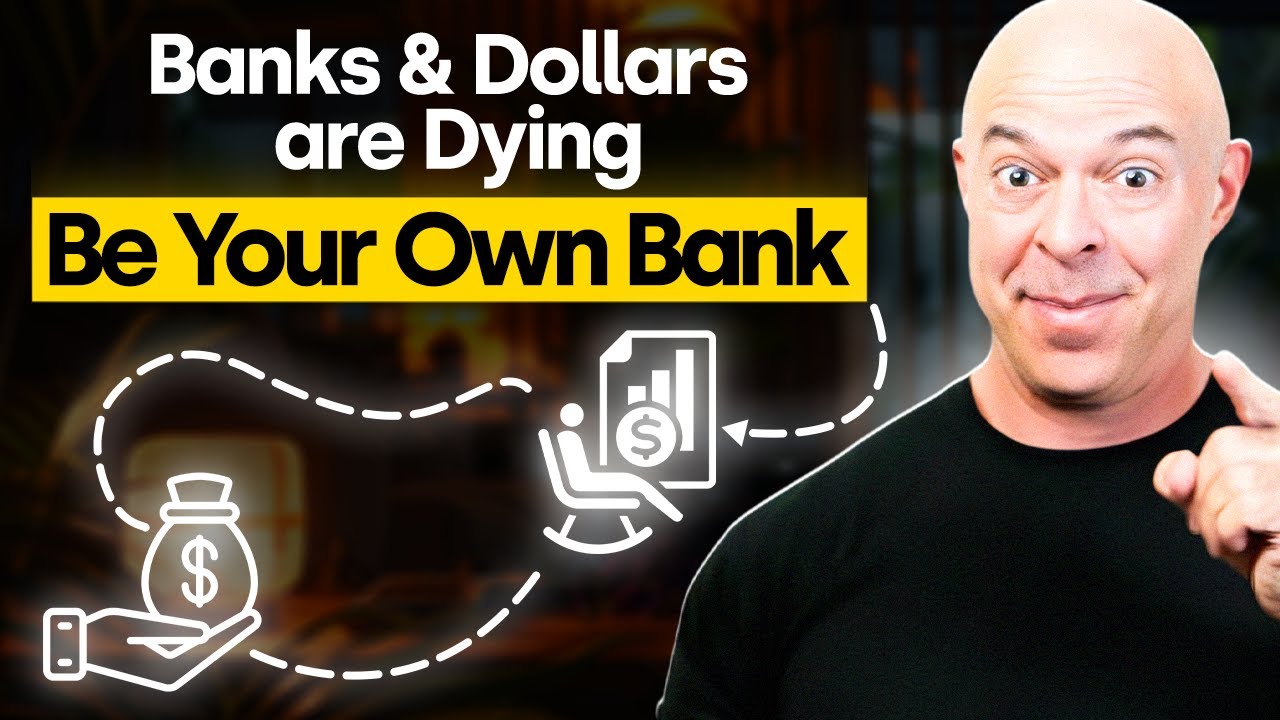
Brian walks through it on video.
Lately that same structure has become available to regular people — through margin loans at a brokerage, and through over-collateralized loans on decentralized exchanges using crypto as collateral. So the question I get is fair: if I can borrow at a lower rate against assets I already own, should I use that to wipe out my credit card debt?
Let's run the math honestly, including the part nobody puts in the thumbnail.
What "borrowing against assets" actually means
You own something of value — shares, gold, crypto, whatever. Instead of selling it, you pledge it as collateral. The lender gives you cash and holds your asset until you pay the loan back. It's the same idea as a car loan: the title is held by someone else until you clear the balance.
Two features make it different from a normal bank loan:
1. You're over-collateralized
The loan is always smaller than the collateral. A typical loan-to-value is around 80%. Post $20,000 of assets, borrow $16,000. That cushion is what protects the lender.
2. There's no approval process
Because the collateral covers the loan, there's nothing to underwrite. No income verification, no employer question, no credit pull, no denial. That's genuinely different from sitting on hold with a bank hoping your score is high enough.
3. The payment schedule is flexible
On many of these loans there's no required monthly payment at all. Interest accrues onto the balance. You pay $500 this month, nothing next month, $1,000 the month after. You control it — as long as the collateral holds its value.
Why the rate can be lower than a bank's
Think about how a bank makes money. You deposit cash and earn somewhere between 1% and 4%. The bank lends that money out at 8%, 12%, sometimes 18% on a car loan. That spread is the whole business model. You're on the losing side of it twice — once as a depositor earning less than inflation, once as a borrower paying the high end.
Cut the middle out and the lender's yield and the borrower's rate meet closer together. That's why collateral-backed loans in this space have been running around 6% rather than 12–18%. The person supplying the money earns more; the person borrowing pays less; the platform takes a transaction fee instead of a fat spread.
That part is real. Now the part that matters more.
The risk that changes everything: liquidation
If your collateral falls below a set threshold, the lender sells some of it to cover the loan. Same concept as a margin call on stocks. You don't get a phone call and a grace period — the position gets trimmed.
That means a loan you took out to pay off a credit card can quietly turn into: card paid off, assets sold at the bottom, loan still outstanding. And unlike a bank deposit, there's no FDIC insurance behind any of it. Regulation is thin. Security is your job.
A worked example with simple numbers
Say you have $10,000 in credit card debt at 18% APR and $20,000 in assets you'd rather not sell.
Option A: keep paying the card
At 18%, you're paying roughly $150 a month in interest alone at the start. Paying $300 a month, you're looking at roughly four years and several thousand dollars of interest before it's gone.
Option B: borrow against the assets at 6%
At 80% LTV, $20,000 of collateral supports a $16,000 loan — plenty. You borrow $10,000, clear the card.
- Interest at 18% on $10,000: about $1,800 a year
- Interest at 6% on $10,000: about $600 a year
- Difference: roughly $1,200 a year in your pocket
On paper, Option B wins by a mile. Here's the honest version.
What has to go right
Your $20,000 in collateral has to stay well above the liquidation line the entire time. If it drops 40% — which is a completely normal move for volatile assets — that $20,000 becomes $12,000 against a $10,000 loan, and you're now uncomfortably close to a forced sale. You'd have to post more collateral or pay down the loan fast, probably at the exact moment your budget is stressed.
And notice what didn't change: you still owe $10,000. You moved the debt to a cheaper, riskier place. You didn't pay it off.
Compare that to the guaranteed option
Paying off an 18% card is a guaranteed, tax-free 18% return. There is no volatility, no liquidation threshold, no platform risk. Nothing in the asset world matches a guaranteed 18% with zero downside.
So before you get clever, run the boring math first. Put your actual balances into the credit card payoff calculator and see what an extra $200 or $300 a month does. Then compare with the Avalanche vs. Snowball tool to pick an attack order. Most people find the plain plan gets them there faster than they expected — and it can't blow up.
When borrowing against assets does make sense
I'm not saying never. I'm saying know what you're doing. It tends to make more sense when:
- You have no high-rate consumer debt left. This is a wealth-preservation tool, not a debt-rescue tool.
- You'd otherwise sell an appreciating asset. Borrowing lets you keep it. If it doubles, you sell a slice, clear the loan, and keep the rest.
- You borrow far below the limit. Not 80% LTV. More like 20–30%, so a big drawdown doesn't liquidate you.
- You can pay it back from income anyway. The loan is a convenience, not a lifeline.
The dollars-versus-assets point underneath all this
Here's the part that's worth taking away even if you never touch a collateral loan. Look at your own balance sheet: house equity, car, brokerage account, gold, jewelry, checking account. Everything is quoted in dollars — but almost none of it is dollars. It's assets with a dollar price tag. The only actual dollars you hold are in checking and savings, and for most people that's a small slice.
That's not an accident, and it's not a bad thing. Dollars lose buying power to inflation year after year. Assets, over long stretches, don't. So the useful lesson isn't "borrow against your Bitcoin." It's: don't let large piles of cash sit still, and don't let high-rate debt sit still either. Both are silent losses.
If you want the fuller picture on that, read why cash alone loses to inflation and the guaranteed return on paying off debt.
A simple order of operations
- Build a small cash buffer so you're never forced into a bad decision. Here's how to do it fast.
- Kill anything over about 10% interest, starting with the highest rate. That's your guaranteed win.
- Then look at where the rest of your money sits, and whether it's keeping up with inflation.
- Only after that consider borrowing against assets — and only at a conservative loan-to-value you could survive a 50% drawdown on.
The bottom line
Borrowing against assets at 6% instead of paying 18% on a card looks like free money, and in a straight-line world it would be. But you're swapping a fixed, boring debt for one that can be liquidated out from under you at the worst possible moment. For most people carrying credit card balances, the better move is unglamorous: attack the highest rate, use the free tools, and get the guaranteed return first.
Build the assets afterward. Then you can borrow against them from a position of strength instead of desperation. Start with the free calculators and see what your real numbers say.