Balance Transfer Calculator
Enter your card, the transfer fee and the 0% offer. You get one answer: what the transfer saves or costs you, and whether you pay it off before the promo ends. Free, no sign-up.
The short answer
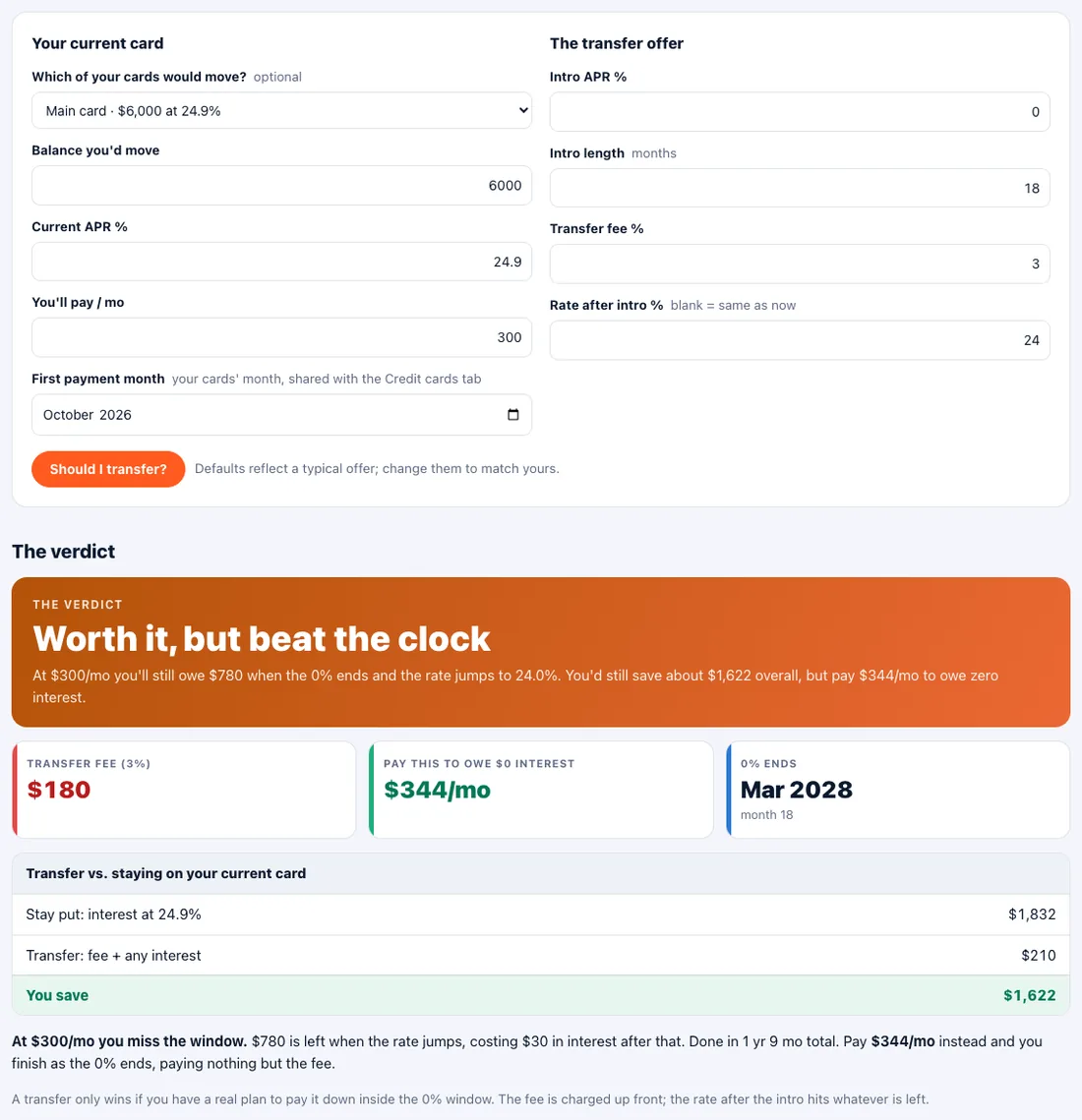
A balance transfer saves you money when the interest you would pay on your current card is bigger than the transfer fee plus any interest you pay after the promo ends. With $6,000 at 24.9%, a 3% fee, 0% for 18 months, 24% after the promo and $300 a month, the transfer saves about $1,622, but $780 is still owed when the 0% ends. Pay $344 a month and you clear it in time.
Want the full plan?
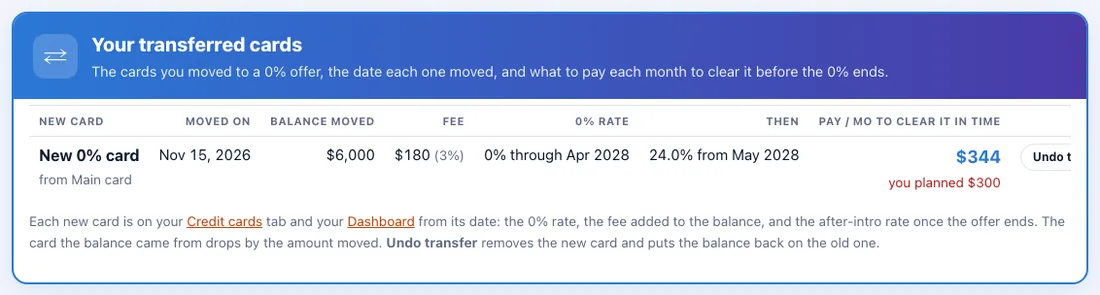
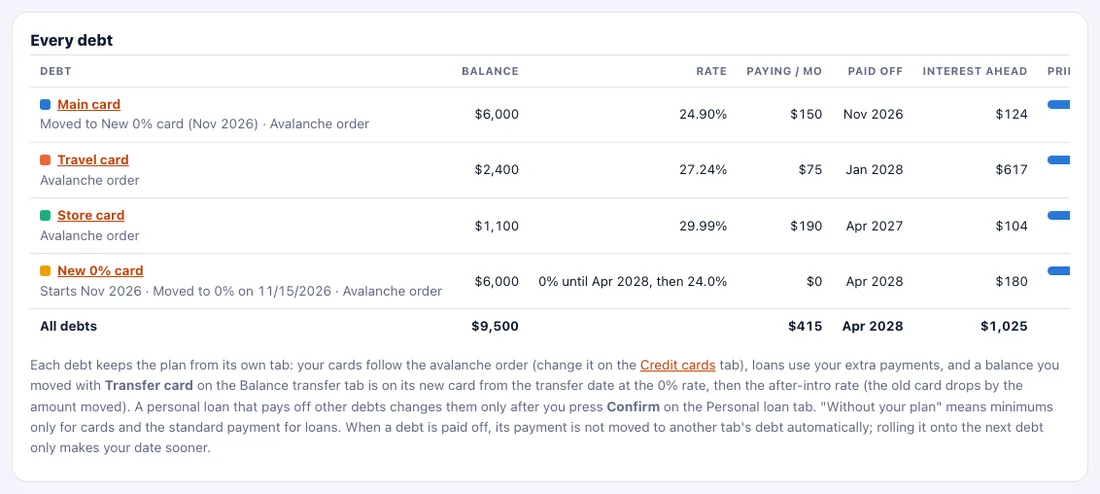
This calculator answers one question for one offer. The Clearora™ Debt Payoff Dashboard puts it inside your whole plan. Screenshots below use sample numbers.
How the balance transfer calculator works
The calculator runs your balance two ways, month by month, with the same payment in both.
Staying put: the balance stays on your current card at its APR. Each month the card charges interest (the APR divided by 12, on what you owe), then your payment comes off. The calculator counts the months until the balance reaches zero and adds up every dollar of interest.
Transferring: the fee is added to the balance on the new card first. A 3% fee on $6,000 is $180, so the new card starts at $6,180. During the promo months the card charges the promo APR (usually 0%). When the promo ends, whatever is left is charged the APR after the promo. The cost of the transfer is the fee plus any interest paid after the promo.
The answer at the top is the difference between the two: the interest you avoid minus what the transfer costs. If that number is positive, you save. If it is negative, the transfer loses money on your numbers. The calculator also tells you whether you finish inside the promo, how much is left when the promo ends, and the monthly payment that clears the whole new balance, fee included, before the rate goes up.
What a balance transfer really costs
Most balance transfer offers charge a fee. Chase's own guide puts the usual fee at 3% to 5% of the amount you move, with a minimum of about $5 to $10. The CFPB says the fee is usually a percentage of the transfer or a fixed amount, whichever is more. The fee is not paid out of pocket: Chase explains that the old balance plus the fee shows up on the new account, which is why the calculator adds it to the new balance.
The fee is charged once, up front, whether you pay the card off in 6 months or 6 years. That is why a transfer pays off best on a balance that would otherwise sit at a high rate for a long time. At 24.9%, $6,000 costs about $125 in interest in the first month alone, so a $180 fee is paid back in under two months of avoided interest. On a card already at a low rate, the same fee may never be earned back.
For context, the Federal Reserve's G.19 release (October 7, 2026) puts the average credit card rate on accounts that paid interest at 22.15% in the second quarter of 2026. If your card is in that range or higher, the fee is usually small next to the interest. If it is far below, run the numbers before you apply.
The promo clock: pay it off before the rate jumps
A 0% rate lasts a set number of months. Federal rules (Regulation Z, section 1026.55) require a promotional rate to last at least six months, and the issuer pages we checked ran 15 to 21 months (Citi Strata 15, Discover 18, Wells Fargo Reflect 21). When it ends, the CFPB notes that the rate on the new card may rise and so may your payment.
The clean way to use a transfer is to divide the new balance by the promo months. $6,180 over 18 months is $343.33, so $344 a month clears it before any interest is charged. Pay less and the leftover moves to the card's regular rate. In the example, $300 a month leaves $780 when the 0% ends, which costs about $30 more in interest before it is gone. The transfer still wins by a wide margin, but the clock matters more when the balance is big and the payment is small.
Three timing details catch people out:
- The transfer window. Many offers only apply to transfers made soon after you open the card. Wells Fargo's Reflect card, for example, says transfers made within 120 days of opening qualify for the intro rate.
- The wait. Chase says a transfer can take several days or even weeks to be approved, and that you should keep paying the old card until it goes through.
- The promo starts when the issuer says. Count your months from the date in your offer, not from the day the balance lands.
When a balance transfer is not worth it
- Your current rate is already low. Type a 0% current APR into the calculator, leave the APR after the promo blank, and you will see the transfer lose exactly the fee.
- You cannot pay much each month. If the payment barely covers the balance during the promo, most of the debt meets the higher rate afterward. Use the "clear it in time" figure as your target, and if it is out of reach, compare a debt consolidation calculator result with a fixed term.
- You might pay late. The CFPB warns that if you are more than 60 days late, the issuer can raise the rate on all balances, including the transferred one.
- The new card is from the same bank. Chase notes that transfers between cards from the same issuer generally are not allowed.
- The old card fills up again. A transfer moves debt; it does not pay it. New spending on the old card puts you back where you started with a second balance.
- New purchases on the new card. The CFPB says that if you use the balance transfer card for new purchases, you won't get a grace period for those purchases, so they can start costing interest right away. This calculator assumes no new purchases.
Balance transfer or consolidation loan?
A balance transfer gives you a short window at a very low rate and leaves the pace up to you. A consolidation loan gives you a fixed rate, a fixed payment and a fixed end date, usually with an origination fee. If you can clear the balance inside the promo, the transfer is normally cheaper. If you need three or more years, compare both. Our debt consolidation calculator runs your cards against a loan the same way this page runs a transfer, and the credit card payoff calculator shows how long one card takes at your current rate.
With several cards, decide the order first: the debt avalanche calculator pays the highest rate first, and the debt snowball calculator pays the smallest balance first. The card that should move to 0% is usually the one with the highest rate that you cannot clear quickly.
More on balance transfers
A new card also changes your credit utilization, the share of your card limits you use. Here is how that affects your score.
Questions about the balance transfer calculator
Is a balance transfer worth it?
It is worth it when the interest you would pay on your current card is bigger than the transfer fee plus any interest after the promo ends. Enter your numbers above: the calculator gives one answer in dollars, you save or you lose.
How much is a balance transfer fee?
Chase's guide puts it at 3% to 5% of the amount you move, usually with a minimum of about $5 to $10. The fee is added to the balance on the new card, so a 3% fee on $6,000 makes the new balance $6,180.
How much do I need to pay to clear a balance transfer before the 0% ends?
Divide the new balance, fee included, by the number of promo months. $6,180 over 18 months is $343.33, so $344 a month. The calculator shows this figure for your offer.
What happens if I do not pay it off before the promo ends?
Whatever is left is charged the card's regular rate from then on. The calculator uses the APR after the promo that you enter, or your current APR if you leave it blank, and counts that interest in the answer.
Can a late payment end a 0% balance transfer?
The CFPB says that if you are more than 60 days late on a payment, the card company can raise the interest rate on all balances, including the transferred balance. Read your offer's terms for anything stricter.
How does a balance transfer credit card work?
Your old balance plus the transfer fee shows up on the new card. A 3% fee on $6,000 makes the new balance $6,180. During the promo months the card charges the promo APR, usually 0%. When the promo ends, whatever is left is charged the APR after the promo. Chase says a transfer can take several days or even weeks to be approved.
How long does the 0% rate last on balance transfer credit cards?
Federal rules (Regulation Z, section 1026.55) require a promotional rate to last at least six months. The issuer pages we checked ran 15 to 21 months: Citi Strata 15, Discover 18 and Wells Fargo Reflect 21. Count your months from the date in your offer, not from the day the balance lands, because the promo starts when the issuer says.
Can I do a cc balance transfer between two cards from the same bank?
Usually not. Chase notes that transfers between cards from the same issuer generally are not allowed, so the 0% card normally comes from a different bank than the card you are paying down. Many offers also only apply to transfers made soon after you open the card. Wells Fargo's Reflect card, for example, counts transfers made within 120 days of opening.
What happens if I use my old credit card and balance transfer card for new purchases?
A transfer moves debt; it does not pay it. New spending on the old card puts you back where you started, now with a second balance. On the new card, the CFPB says new purchases don't get a grace period, so they can start costing interest right away. This calculator assumes no new purchases on either card.
What timing details catch people out with a credit card with balance transfer?
Three of them. Many offers only apply to transfers made soon after you open the card. Wells Fargo's Reflect card counts transfers made within 120 days of opening. Chase says a transfer can take several days or even weeks to be approved, and to keep paying the old card until it goes through. And the promo starts when the issuer says, so count months from the date in your offer.
How we calculate
Interest each month is the APR divided by 12, charged on the balance at the start of the month, then your payment comes off. That is a consistent monthly estimate. Many card issuers charge a daily periodic rate on daily or average daily balances, so your statements, payoff month and interest can differ. The transfer fee is a percentage of the balance you move and is added to the new card's balance. A minimum fee (often $5 or $10) is not included, which only matters on very small transfers. Results are estimates from the numbers you type, not an offer from any issuer.
Sources, read October 28, 2026: CFPB, "What do I need to know about consolidating my credit card debt?" (reviewed September 2, 2026); Regulation Z, 12 CFR 1026.55 (b)(1) and (b)(4); Chase, "What is a balance transfer?" and "Are balance transfers worth it?"; Wells Fargo Reflect card; Discover balance transfer; Citi balance transfer cards; Federal Reserve, G.19 Consumer Credit (October 7, 2026).