Debt Consolidation Calculator
Enter the cards you would pay off and the loan offer, origination fee included. See both monthly payments, the interest, the months and one answer: the loan saves you money or it does not. Free, no sign-up.
The short answer
A consolidation loan saves you money when the loan's interest plus its origination fee is less than the interest your cards would cost at the payments you make now. Example: three cards totaling $9,500, paid $300 a month, cost $6,864 in interest over 58 months. A 36-month loan at 11.9% with a 5% fee costs $2,440 ($1,940 interest plus the $500 fee) at $331.67 a month, so it saves about $4,424.
Want the full plan?
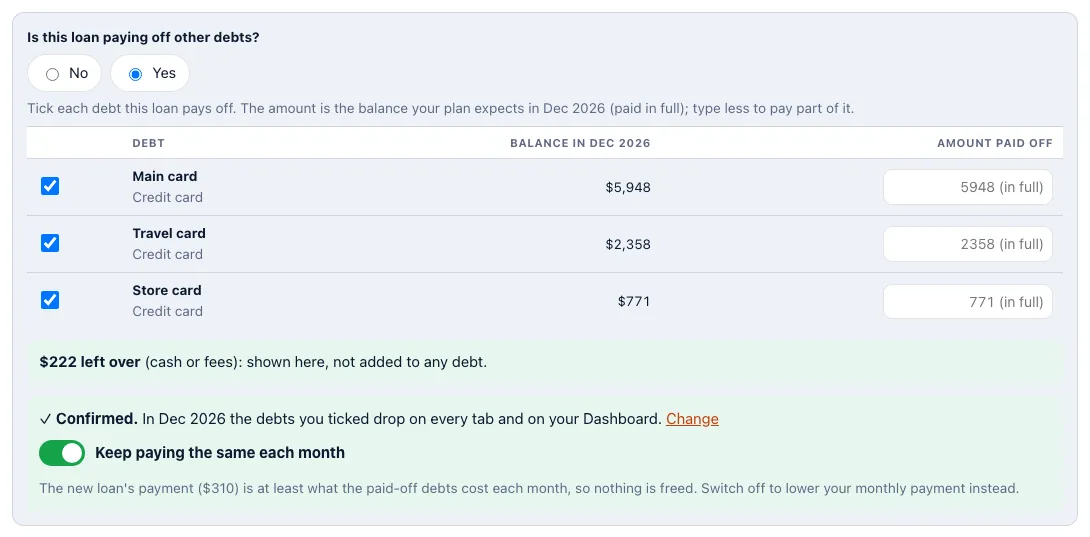
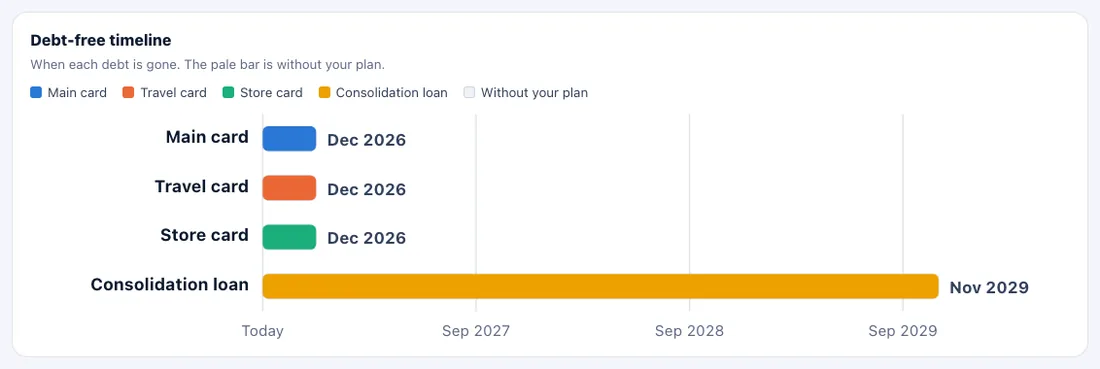
This calculator answers one question for one offer. The Clearora™ Debt Payoff Dashboard puts it inside your whole plan. Screenshots below use sample numbers.
How the debt consolidation calculator works
Enter each card you would pay off with the loan: its balance, its APR and what you pay on it each month. Then enter the loan offer: the interest rate, the term in months and the origination fee. Leave the loan amount blank and the calculator sizes the loan for you.
Your cards: each card is paid on its own at the payment you typed until it reaches zero. Interest is the APR divided by 12, charged on each card's balance every month. The calculator shows what you pay each month in total, how many months until the last card is paid off, and the total interest.
The loan: the loan's monthly payment is the standard fixed payment that pays it off in the term you chose, rounded to the cent. The total cost of the loan is its interest plus the origination fee.
The answer is the card interest minus the loan's cost. Positive means the loan saves you that much over its life. Negative means your cards, paid as you pay them now, are cheaper. Under the answer you see both monthly payments, so you also know whether the loan lowers or raises what you send each month.
A worked example, step by step
The calculator opens with three sample cards: $6,000 at 24.9% paid $180 a month, $2,400 at 27.24% paid $75, and $1,100 at 29.99% paid $45. That is $9,500 of debt and $300 a month. Paid that way, the two bigger cards take 58 months and the small one 39, and the three together cost $6,864 in interest.
The sample loan is 36 months at 11.9% with a 5% origination fee. To clear $9,500 after a 5% fee, the loan has to be $10,000: the lender keeps $500 and pays out $9,500. The fixed payment on $10,000 over 36 months at 11.9% is $331.67, and the interest over the loan comes to $1,940. Add the $500 fee and the loan costs $2,440.
$6,864 minus $2,440 is about $4,424 saved, and the debt is gone 22 months sooner, for $31.67 more a month. The two sides use different payments, though: if you can afford $331.67 for the loan, you could also send it to your cards. Paying $211.67 instead of $180 on the $6,000 card (the same $331.67 in total) brings the card interest down to $5,696, and the loan still saves about $3,256. Change any number above and the answer follows.
The origination fee: why you may need to borrow more than you owe
Many personal loans charge an origination fee and take it out of the money you receive. Upgrade, for example, lists an origination fee of 1.85% to 9.99% that is deducted from the loan proceeds, and its own example says a $10,000 loan with a 5% fee pays out $9,500. If your cards total $9,500, that $10,000 loan is the smallest one that clears them, and you repay the whole $10,000 plus interest.
That is why the calculator, with the amount left blank, borrows enough to cover your cards after the fee. If you type an amount that is too small, it tells you how much of your cards would be left unpaid. If you type more than you need, the extra cash is shown separately and is not counted as a cost, because it is still your money (though you pay interest on it).
The fee is also why the loan's APR can be higher than its interest rate. The CFPB explains that the APR is the interest rate plus fees charged with the loan, origination charges included. When you compare offers, compare APRs, or type the interest rate and the fee here separately.
A lower payment is not the same as a cheaper loan
Stretching a loan lowers the payment and raises the total. Run the example again with a 60-month term: the payment drops from $331.67 to $221.94, and the loan now costs about $3,816 in interest and fees, so the saving shrinks from $4,424 to about $3,048. The CFPB makes the same point: a lower monthly payment may come from paying over a longer time, and you can end up paying more overall once fees and costs are counted.
The CFPB also warns that some low consolidation rates are teaser rates that only last for a while. This calculator assumes one fixed rate for the whole loan, and many personal loans have a fixed rate; if your offer's rate can change, ask the lender what it becomes and when.
For context, the Federal Reserve's G.19 release (October 7, 2026) shows an average rate of 11.86% on 24-month personal loans at commercial banks and 22.15% on credit card accounts that paid interest, both for the second quarter of 2026. Your own offer depends on your credit and the lender.
What this comparison leaves out
- Rolling payments. Here each card keeps its own payment. If you would move a paid-off card's payment onto the next card, your cards finish sooner and cost less. The debt avalanche calculator and the debt snowball calculator show that plan.
- New spending. The CFPB notes that consolidating can just put off the problem if spending is not reduced. Paid-off cards with open limits are the usual way it happens.
- Approval. The rate you're offered after you apply may differ from the rate advertised. Run the calculator again with the real offer before you sign.
- Debt settlement offers. Some companies that advertise consolidation are debt settlement companies. The CFPB says they may charge fees up front and tell you to stop paying your debts, and calls that risky. This calculator compares a plain loan, nothing else.
Consolidation loan or balance transfer?
A 0% balance transfer can beat a loan if you can pay the balance off before the promo ends, because the only cost may be the transfer fee. If you need years rather than months, a fixed loan gives you a set end date. Try both: the balance transfer calculator gives one answer for a 0% offer, and the debt reduction calculator shows what extra payments do to one loan once you have it.
More on consolidation
Applying for a loan? Lenders look at your debt-to-income ratio: the debt-to-income calculator shows yours and how much your payments would have to fall to lower it.
A loan is one of several ways out. Our page on debt relief options compares it with credit counseling, debt management plans, settlement and bankruptcy, including the risks.
Questions about the debt consolidation calculator
Does a debt consolidation loan save money?
Only when the loan's interest plus its origination fee is less than the interest your cards would cost at the payments you make now. Enter your cards and the offer above and the calculator gives the difference in dollars.
How does the origination fee change the loan?
Many lenders take the fee out of the money you receive. With a 5% fee, a $10,000 loan pays out $9,500, so to clear $9,500 of cards you borrow $10,000 and repay all of it. Leave the loan amount blank and the calculator sizes the loan for you.
Why can a lower monthly payment cost more?
A lower payment usually comes from a longer term, and more months means more interest. In the example, the same loan over 60 months instead of 36 drops the payment from $331.67 to $221.94 but costs about $1,376 more.
What APR should I enter for the loan?
Enter the interest rate from the offer and the fee separately. The APR a lender shows already includes fees such as origination charges, so typing the APR and the fee would count the fee twice.
Is a balance transfer better than a consolidation loan?
If you can pay the balance off before a 0% promo ends, a transfer often costs only its fee. If you need several years, a fixed loan gives you a set end date. Run both: the balance transfer calculator answers the same question for a 0% offer.
What do debt consolidation lenders look at when you apply?
Lenders look at your debt-to-income ratio, and the offer you get depends on your credit and the lender. The rate you're offered after you apply may differ from the advertised rate, so run the calculator again with the real offer before you sign. The debt-to-income calculator shows your ratio and how much your payments would have to fall to lower it.
Does a debt consolidation personal loan have a fixed rate?
Many personal loans have a fixed rate, and this calculator assumes one fixed rate for the whole loan. The CFPB warns that some low consolidation rates are teaser rates that only last for a while. If your offer's rate can change, ask the lender what it becomes and when.
How do I find the best consolidation loan for my credit card debt?
This calculator does not rank lenders. It shows what each offer costs you. Type each offer's interest rate, term and origination fee separately, and the loan with the lowest interest plus fee for your cards is the cheaper one. Watch the term: a longer loan lowers the payment but raises the total. The rate you're offered after you apply may differ from the advertised rate.
How do rates on a personal loan for debt consolidation compare with credit card rates?
The Federal Reserve's G.19 release (October 7, 2026) shows an average rate of 11.86% on 24-month personal loans at commercial banks and 22.15% on credit card accounts that paid interest, both for the second quarter of 2026. Your own offer depends on your credit and the lender, and the rate you're offered after you apply may differ from the advertised rate.
How we calculate
Interest each month is the rate divided by 12 (each card's APR, the loan's interest rate), charged on the balance at the start of the month, then the payment comes off. Many card issuers charge a daily rate on daily balances, so real statements can differ. The loan payment is the fixed payment that pays the loan off in the term you chose, rounded to the cent; the last payment is whatever is left. The origination fee is a percentage of the loan amount, taken out of the money you receive. Checked against a lender's published example: $10,000 over 36 months at a 13.94% rate gives $341.48 a month, the same payment the lender states. Results are estimates from the numbers you type, not a loan offer.
Sources, read October 28, 2026: CFPB, "What do I need to know about consolidating my credit card debt?" (reviewed September 2, 2026) and "What is the difference between a loan interest rate and the APR?" (reviewed August 28, 2026); Upgrade personal loans (footnote on origination fees and the payment example); Federal Reserve, G.19 Consumer Credit (October 7, 2026).