How to Pay Off Credit Card Debt Fast: The Real Math
If you've searched for how to pay off credit card debt fast, you've probably already read the generic advice: "spend less, pay more." True, but useless without numbers. What actually changes behavior is seeing what the debt costs you in dollars — and what a specific extra payment buys back.
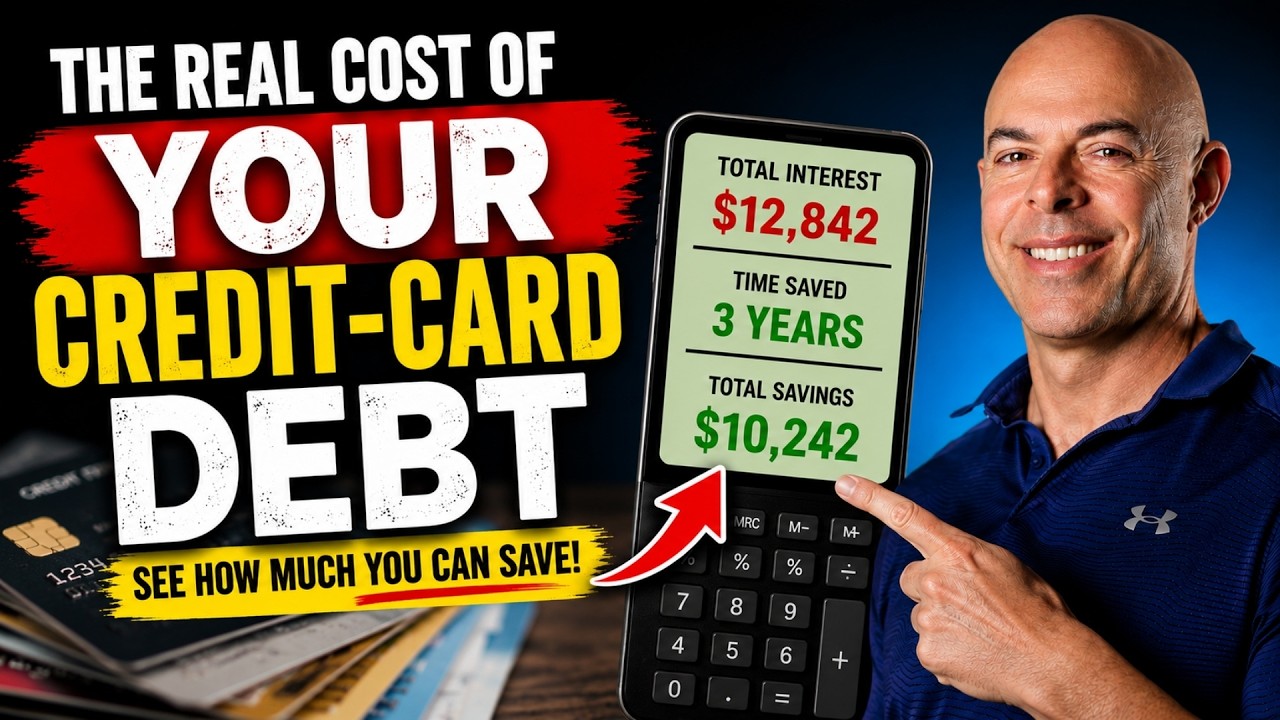
Brian walks through it on video.
So let's do the math out loud, with simple numbers you can copy for your own situation.
The mistake almost everyone makes
Most people look at a statement and think: I owe $12,000, so I have to pay back $12,000. Then it's done.
That's not how revolving credit works. You pay back the balance plus interest on whatever balance is still sitting there, month after month, for as long as it takes. Stretch the payoff over 13 years and you pay interest 156 times. Stretch it over 3 years and you pay it 36 times on a shrinking balance. Same debt. Wildly different price.
Where your payment actually goes
Every payment splits into two pieces:
- Principal — the part that reduces what you owe.
- Interest — your current balance multiplied by your rate, divided across the year.
The minimum payment is designed so that, early on, a large share is interest. The balance barely moves. That's not a conspiracy, it's just how the formula works — and it's why paying the minimum feels like running on a treadmill.
Here's the key fact: anything you pay above the minimum goes straight to principal. There's no fee, no penalty, no clever trick required. It just lands on the balance and shrinks the number the interest rate gets multiplied by next month.
A worked example: $12,000 at 24%
Take a single card with numbers that are painfully common right now:
- Balance: $12,000
- APR: 24%
- Minimum payment: $250
Run that through a payoff calculator and here's what happens.
| Monthly payment | Time to payoff | Total interest | Interest saved |
|---|---|---|---|
| $250 (minimum only) | About 13 years | About $28,000 | — |
| $400 (extra $150) | Just a few years | About $6,000 | About $22,000 |
| $500 (extra $250) | About 2 years, 10 months | About $4,511 | About $24,000 |
Read that top row again. A $12,000 balance costs about $28,000 in interest if you only ever send the minimum. You pay back more than three times what you borrowed.
Now read the bottom row. An extra $250 a month — the same money, just redirected — cuts the payoff from roughly 13 years to under 3, and saves about $24,000.
And if $250 is out of reach? The middle row is the one to sit with. An extra $150 a month still saves about $22,000. Most of the benefit shows up early. You do not need a perfect plan. You need a plan that starts.
"But I want to keep that $150"
Fair. Nobody enjoys sending $400 to a bank instead of $250. Just be honest about the price of that choice: keeping $150 a month in your pocket for the next decade costs you somewhere around $22,000 in interest, plus ten extra years of having a payment at all.
Paying extra doesn't only save time. It saves money. Those are two different wins and you get both.
What about two or three cards?
Most households don't have one card. Say you add a second:
- Card 1: $12,000 at 24%, minimum $250
- Card 2: $6,000 at 18%, minimum $125
Paying only the minimums — $375 a month total — that's roughly ten years to clear both, with total interest in the neighborhood of $33,000.
Add $300 a month between the two of you and total interest drops to about $6,000. That's roughly $26,000 saved. Twenty-six thousand dollars is a car off the lot. It's a serious chunk of college. It's a real emergency fund instead of a credit card you call an emergency fund.
The rule that makes multi-card payoff work
When card one is paid off, do not drop your total payment back down. Keep sending $375 (or whatever your total is) and push the freed-up $250 onto card two. Now card two gets $375 a month instead of $125 and it collapses fast.
That rolling payment is the engine behind both the avalanche and the snowball method:
- Avalanche — attack the highest interest rate first. Saves the most money. Try the debt avalanche calculator or the Avalanche Debt Eliminator.
- Snowball — attack the smallest balance first. Gives you a win sooner, which keeps some people going. Try the debt snowball calculator.
If you can't decide, run both and look at the difference: avalanche vs. snowball. The best method is the one you'll actually stick with for two years.
Step by step: build your payoff plan today
- Gather your statements. For each card, write down the balance, the APR and the minimum payment. Every number you need is printed there.
- Run minimums only first. Put those numbers in the credit card payoff calculator with no extra payment. Write down the payoff date and the total interest. This is your baseline — the cost of changing nothing.
- Add an extra amount and compare. Try $50. Try $150. Try $300. Watch the interest number fall. This is the moment the math stops being abstract.
- Pick a number you can actually hit. An extra $100 you pay every month beats an extra $400 you manage twice and then abandon.
- Find the money. More on this below.
- Automate it. Set the total payment to go out automatically so it isn't a monthly decision.
- Roll payments forward. When a card dies, its payment moves to the next card. Never shrink the total.
- Track it. Watching balances drop is what keeps you going. Use the Debt-Freedom Tracker.
Where does the extra money come from?
Sometimes it's income — a second job, overtime, selling things you don't use, a side gig for a defined stretch of time. Sometimes it's simply a household decision: for the next year or two, we're pausing certain spending. Eating out less. Cutting the grass ourselves instead of paying someone. Dropping subscriptions we forgot we had.
The word that makes this bearable is temporary. You are not giving these things up forever. You're renting them out for 24 months to buy back a decade of payments. For a specific list of what to cut first, read how to pay off credit card debt fast by cutting expenses temporarily and watch give up these expenses until your credit cards are paid off.
Should you consider a balance transfer?
Moving a balance to a lower promotional rate can help — but only if you keep paying the same aggressive amount, and only if the transfer fee is smaller than the interest you avoid. Run the numbers with the balance transfer break-even tool before you apply. A transfer that becomes an excuse to slow down is worse than no transfer at all.
What about the rest of the debt?
Credit cards usually carry the highest rates, so they're the right first target. Once they're gone, that freed-up payment is a weapon. Point it at the car with the auto loan early payoff calculator or at the house with the Mortgage Payoff Accelerator. Same principle, bigger numbers.
The bottom line
Paying the minimum on a $12,000 card at 24% can cost you around $28,000 in interest and 13 years of your life. Adding $150 a month saves roughly $22,000. Adding $250 saves roughly $24,000 and gets you free in under three years.
That saved money isn't theoretical. It's a bike at Target. It's soccer balls and school clothes and a backpack. It's a car. It's what you can do for your kids, your parents or yourself when you're not renting your paycheck to a bank.
The government isn't going to fix this for you and the banks aren't either. Run your own numbers, pick a number you can hit, and start. Grab a calculator from the free calculators page or see the full step-by-step system on the get out of debt page.