What Credit Card Debt Really Costs You (And How Paying Extra Saves Thousands)
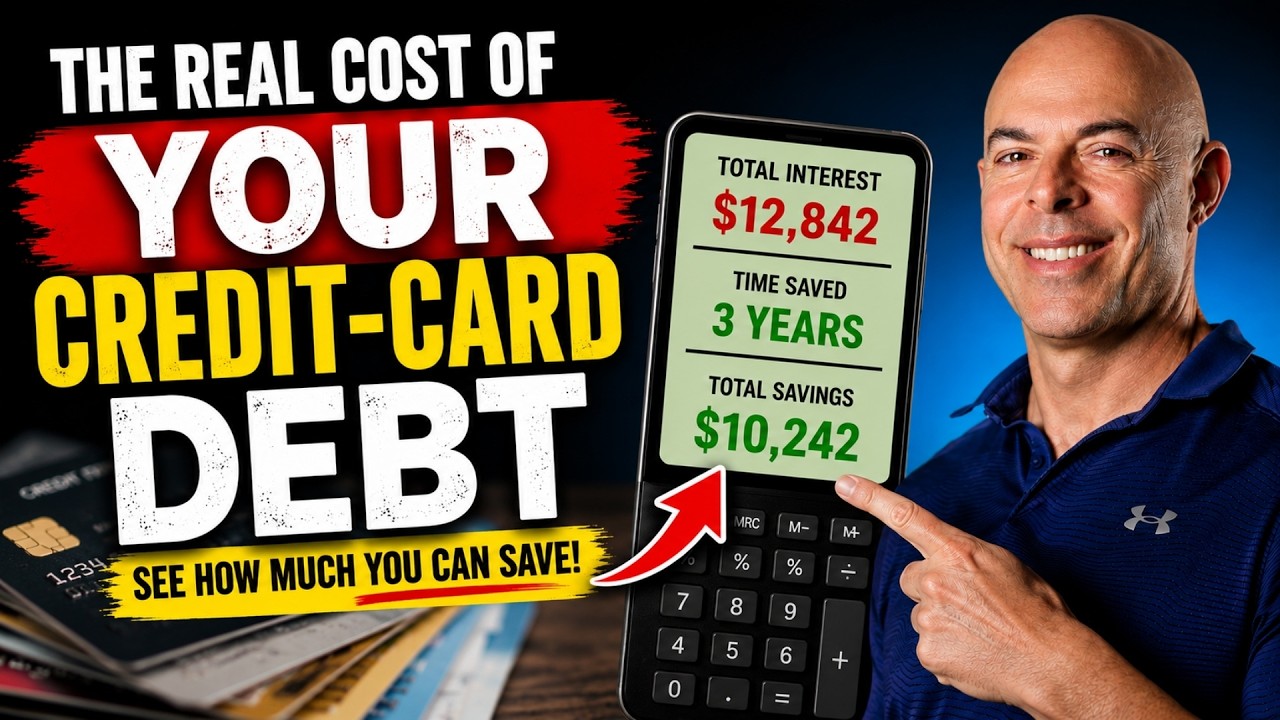
Most people look at a credit card balance and think, "I owe $12,000, so I have to pay back $12,000." That's not how it works. In this video I open up a payoff calculator, plug in real numbers, and show you exactly how much interest a minimum payment costs you — and how much you get back when you add even a little extra each month.
No shame, no hype. Just the math, so you can decide what you want to do with your own money.
What you'll learn
- Why the total interest on a credit card can be more than the balance itself
- How a payment splits between principal and interest — and why that matters
- What happens when you add $150 or $250 a month to a $12,000 card at 24%
- How the numbers change when you add a second card to the plan
- Where to find the money for the extra payment without a second job (or with one)
Why a couple thousand dollars is worth caring about
I start the video with a question: what could you do for your kids, your family or your parents with an extra couple thousand dollars? A bike at Target is about $150. Soccer balls, footballs, art supplies, crayons and paper, a calculator, new clothes, a backpack for school. Those things add up. When you're deep in payments, "saving $2,000" sounds abstract. Put it in terms of what that money actually buys and it stops being abstract fast.
One card, one minimum payment, 13 years
I open the calculator and enter a made-up card: a $12,000 balance, a 24% APR — which is about where cards sit right now — and a $250 minimum payment. All three of those numbers are on your statement, so this isn't guesswork.
Build the plan and here's what comes back: debt free in about 13 years, and total interest of roughly $28,000. On a $12,000 balance. That's more than double what you borrowed, and it happens because the minimum payment is so low that most of it is eaten by interest every month.
Principal versus interest, in plain English
When you send in $250, that payment splits in two. Part goes to the principal — the actual debt — and part goes to interest, which is your balance multiplied by the rate. So the faster you knock the balance down, the smaller that interest slice gets every single month. Extra money you send goes straight to principal. That's the whole game.
What adding $250 a month does
I bump the extra payment to $250, so the total is $500 a month instead of $250. The result: total interest drops to about $4,511, payoff time drops to about two years and ten months, and the savings come in around $24,000.
Then I dial it back, because not everybody has $250 spare. At an extra $150 a month — $400 total — interest lands near $6,000 and you still save roughly $22,000. You might say you'd rather keep that $150 in your pocket. Fine, but understand what that choice costs: significantly more interest over time. You're not just buying time. You're buying money back.
Adding a second card
Then I add card two: a $6,000 balance at 18% with a $125 minimum, maybe your spouse's card. With no extra payments, the plan shows about ten years to clear both and total interest around $33,000. The calculator lists every month and tells you exactly where to send each dollar — $250 here, $125 there, $375 total.
It also does the thing most people miss: when the first card is paid off, you keep sending $375 and roll that freed-up payment onto the other card. That's the avalanche idea, and I cover it in depth elsewhere. Add $300 a month between the two of you and total interest falls from about $33,000 to around $6,000 — roughly $26,000 saved. That's a car off the lot. That's college money.
Where the extra money comes from
Sometimes it's another job. Often it's just deciding, as a household, that for the next year or two you're going to stop doing X, Y and Z — eating out less, cutting your own grass, whatever it is for you. Figure it out, get the money in there, and build a plan. The government doesn't care about you. The banks don't care about you. It's on you to take control of your financial future — so don't put your head in the sand.
Key steps
- Pull your latest statement and write down the balance, APR and minimum payment for every card.
- Run those numbers through the credit card payoff calculator with minimums only, so you see the true interest cost of doing nothing.
- Add an extra amount — even $50 or $150 — and compare the interest and payoff date.
- Find that money in your budget. Start with the expenses worth cutting temporarily.
- When a card is paid off, roll its payment onto the next one instead of spending it. See the debt avalanche calculator.
- Track it every month so you can see the balance move. Use the Debt-Freedom Tracker.
FAQ
Why does a $12,000 balance cost $28,000 in interest?
Because the minimum payment is set very low. At 24% APR, most of a $250 payment goes to interest in the early years, so the balance barely moves and you keep paying interest on nearly the full amount for over a decade. Interest is charged on whatever balance is left, so a slow payoff means a very expensive one.
Does extra money go to the principal or the interest?
Extra money above the minimum goes straight to the principal. That's why an extra $150 a month can cut more than a decade off the payoff and save over $20,000 — you're shrinking the number the interest rate gets multiplied by.
Should I pay off the highest rate or the smallest balance first?
Both work as long as you keep rolling paid-off payments forward. Highest rate first (avalanche) saves the most interest; smallest balance first (snowball) gives faster wins. Compare them side by side with the avalanche vs. snowball tool, or browse all the free calculators.
The step-by-step written version, with a worked example.