Lump Sum Payment on Credit Card Debt: How Much It Really Saves
A tax refund shows up. An aunt hands you $1,000 at Christmas. You clean out the garage and a yard sale nets you a few hundred bucks. The question everybody asks is the same: does throwing that at credit card debt actually help, or does it just disappear into the balance?
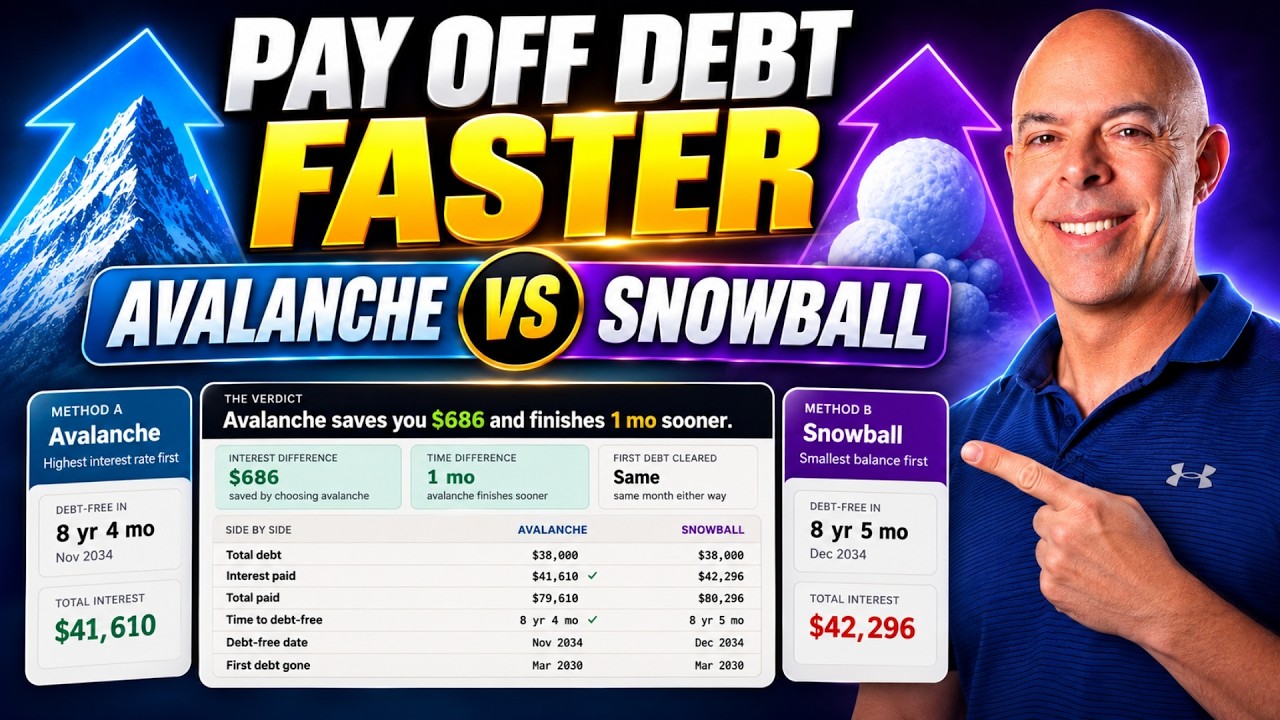
Brian walks through it on video.
It helps more than most people think. And the reason is boring, mechanical math — not motivation, not willpower. Let me walk through it.
Why a lump sum works: interest is calculated on your balance
That's the whole secret. Your credit card company doesn't charge you interest on the debt you originally borrowed. It charges interest on whatever you owe right now. Lower the balance today and every single month from here forward costs you less in interest.
That's different from how people picture it. Most people think of a lump sum as "one payment, one month of progress." It isn't. It's one payment that lowers the interest meter for the entire rest of your payoff.
The critical detail: say the words "apply to principal"
When you send a big one-time payment, tell the credit card company or the lender that it goes to principal. Don't assume. Some lenders will treat extra money as a prepayment of future minimums, which does not help you the same way. You want the balance itself knocked down.
A simple worked example
Let's keep the numbers clean so you can follow the math in your head.
Say you owe $12,000 on a credit card at 24% APR. 24% a year is 2% a month — actually let's use 1% a month on a 12% card to be simple, but we'll stay with 24% because that's what a lot of real cards look like, so it's 2% per month.
| Balance | Monthly interest at 24% APR |
|---|---|
| $12,000 | $240 |
| $11,000 | $220 |
| $9,000 | $180 |
| $6,000 | $120 |
Now drop $1,000 on it. Your balance goes from $12,000 to $11,000, and your interest that month drops from $240 to $220. That's $20.
"Twenty bucks? That's it?" No — that's $20 this month. Next month you're still $1,000 lower than you would have been, so it's roughly another $20. And the month after that. If you had 30 months left on the card, that's roughly $600 in interest you never pay, on top of the $1,000 that went straight to the balance.
And it compounds in your favor: because you're paying less interest each month, more of your regular payment goes to principal, so the balance falls faster, so the interest falls faster again. That's why the calculators show lump sums cutting months off the payoff date, not just dollars off the total.
Earlier beats bigger
A $1,000 payment in month six of a six-year payoff saves you far more than a $1,000 payment in month fifty. Same money, different number of months benefiting from the lower balance. If you're sitting on cash and debating whether to wait for a "better moment," the math says the better moment was earlier.
You are not paying more — you're paying sooner
This trips people up. If you owe $31,000 total and you drop an extra $1,000 into it, you have not now committed to paying $32,000. You still owe $31,000. You just delivered part of it sooner, which means less of your money goes to interest. The lump sum isn't extra spending. It's the same debt, paid on a faster schedule.
Where should the lump sum go?
If you have multiple debts, the same question comes up as with monthly payments: highest interest rate, or smallest balance?
Highest interest rate (avalanche logic)
Mathematically, a dollar removed from a 24% card saves three times as much interest as a dollar removed from an 8% car loan. If your goal is the lowest total cost, send the lump sum to the highest-rate debt.
Smallest balance (snowball logic)
If the lump sum is big enough to completely wipe out a small debt, there's a real case for that. Killing a debt entirely frees its minimum payment permanently, and that freed-up money then rolls into the next debt every month for the rest of your payoff. It also feels good, and feeling good is part of finishing.
A practical rule: if the lump sum erases a debt completely, seriously consider doing it. If it only dents a balance, put it on the highest rate. Either way, run it both ways in the avalanche vs. snowball tool before you send the money — it takes two minutes and you'll see the actual dollar difference on your debts, not a generic one.
What if you don't have a lump sum coming?
Then you build one, and there are only two levers.
Lever one: cut expenses temporarily
Not forever — until the debt is gone. Someone cleans your house. Someone cuts your yard. You've got streaming services, delivery subscriptions, apps you forgot you're paying for. Cut a few and you might free $200 a month. Do that for five months and you've manufactured your own $1,000 lump sum. There's a full breakdown in this guide on cutting expenses temporarily.
Lever two: earn more
A raise. Driving rideshare two nights a week. Babysitting. Selling the stuff sitting in your garage. It doesn't have to be glamorous and it doesn't have to be permanent. An extra $300 a month is roughly $75 a week.
Combine both levers and $500 a month of extra payments is realistic for a lot of households. That's a $1,000 lump sum every two months, forever, until the debt's gone.
How to actually check your own numbers
- Pull every statement. Write down the balance, the APR and the minimum payment for each debt.
- Enter them into a credit card payoff calculator and note your baseline: total interest and payoff date on minimums alone.
- Add your extra monthly amount and watch both numbers move.
- Add the one-time payment and the month you'll actually send it. Compare again.
- Open the month-by-month view so you know exactly what to send, to which account, every month.
The month-by-month view is the part that turns a plan into instructions. When a debt gets paid off, its payment doesn't vanish — you roll it into the next one. A $250 payment plus a freed-up $300 becomes $550. Then $750. That's the engine, and a lump sum just starts it earlier.
Don't forget what the time savings are worth
People fixate on interest saved and ignore months saved. If minimums had you paying for six years and your plan gets you there in four, that's two full years where the money you were sending to lenders is yours again. If you were sending $950 a month, that's $950 a month freed up twenty-four months sooner — to save, to invest, to breathe.
The bottom line
A one-time payment doesn't just reduce your debt by the amount you paid. It reduces the balance that every future interest charge is calculated on, which is why a $1,000 payment made early can be worth well over $1,000 to you. Tell the lender it's going to principal, put it where it does the most work, and check your own numbers instead of guessing.
The government doesn't care about your balance. The banks don't care about your balance. If you want control of your financial future, you have to take it. Start with the free calculators and see what your real numbers say.