Avalanche vs. Snowball: Which Debt Payoff Method Actually Wins?
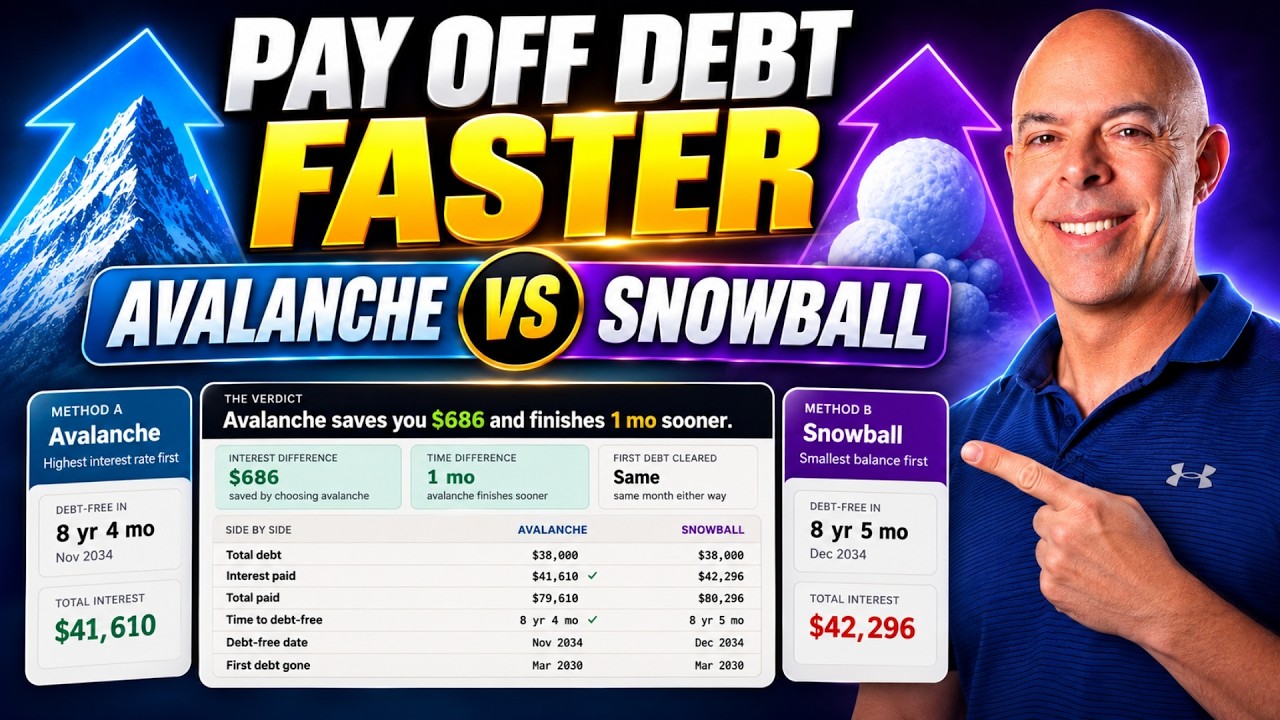
You've probably heard of both the debt avalanche and the debt snowball. In this video I explain exactly how each one works, then I put the same three debts — two credit cards and a car loan — side by side in a calculator so you can see which method wins and why.
Then I do the part most people skip: I add extra monthly money and one-time payments to see how much faster the debt actually disappears.
What you'll learn
- The one-sentence difference between avalanche and snowball
- What happens month by month when a debt gets paid off and that payment rolls forward
- Side-by-side interest totals on the exact same three debts
- How an extra $200 or $300 a month changes both interest and time
- Why a one-time payment saves so much — especially early
The two methods, in one sentence each
Avalanche means you attack the highest interest rate first. Snowball means you attack the smallest balance first. That's literally the whole difference. Everything else — the minimum payments, the rolling forward of freed-up money — works the same way in both.
The example I used
I listed three debts: Card 1 with a $14,000 balance at 24% APR and a $250 minimum, Card 2 with $9,000 at 20% APR and a $200 minimum, and a car loan at 8% APR with a $300 payment. Total debt came out around $31,000. You can find every one of those numbers on your own statements, and in the calculator you can type in whatever your real numbers are.
With the avalanche, the calculator sorts by interest rate, so Card 1 at 24% is the target. With the snowball, it sorts by balance, so Card 2 at $9,000 gets attacked first. Same debts, same APRs, same minimums — just a different target.
What the side-by-side showed
On minimums alone, avalanche came out to $36,823 in total interest and snowball came out to $37,087. Same amount of time, a little less money with avalanche. Not dramatic yet — but watch what happens when you add money.
Month-by-month is where it clicks
Click into the month-by-month view and each row is a month showing exactly what you send to each debt. In this example the car loan happened to finish first — the last month only had $26 left on it. That frees up $300. Under avalanche, that $300 goes to the 24% card, so the $250 payment becomes $550. When the next card is paid off, its $200 rolls in too and you're sending $750. Under snowball, that same freed-up $300 goes to the smallest balance instead, so $200 becomes $500, and that card disappears fast.
That's the snowball's real argument, and it's a fair one: it's psychological. Knocking out a whole debt feels good and keeps you going. But you still want to look at the method that saves you the most money.
Adding extra money and one-time payments
There are only two levers: spend less or earn more. In the example I cut $200 a month of expenses — house cleaning, yard work, a few subscriptions you can live without until the debt is gone. With that $200 added, avalanche saved about $1,400 in interest and a month of time versus snowball. Add $300 more from extra income and both the money and time savings grow again.
Then the one-time payment. Say your favorite aunt hands you $1,000 at Christmas and you send it in during month six. Make sure you tell the lender it goes to principal. That one payment cut interest by about $1,420 and two months off the payoff. And no — you're not paying an extra $1,000. Your total debt is still about $31,000. You just knocked the balance down faster, and interest is calculated on the balance.
The time savings matter as much as the money. If minimums had you paying almost six years and the plan gets you to four, that $950 a month is yours again two years sooner. Save it, invest it, whatever you want — it's there.
Key steps
- Pull your statements and write down every balance, APR and minimum payment.
- Enter them into a calculator and run both methods side by side.
- Pick the method you'll actually stick with, knowing what the difference costs.
- Find extra money: cut expenses, add income, or both.
- Open the month-by-month view so you know exactly where each dollar goes.
- Apply any windfall as a one-time payment to principal, as early as you can.
FAQ
Is avalanche always cheaper than snowball?
Mathematically it targets the highest interest first, so it's built to save the most in interest. In my example it won by $264 on minimums and about $1,400 once I added $200 a month. But the method you finish beats the method you quit. Run your own numbers in the avalanche calculator and the snowball calculator and see the gap for yourself.
Why does a one-time payment save so much interest?
Because interest is calculated on your balance. Drop the balance and every month after that costs you less. The earlier you send it, the more months benefit — which is why a $1,000 payment in month six cut about $1,420 in interest in my example.
What if I can't find any extra money right now?
Start with the two levers: lower expenses or higher income. I walk through expenses in this video on cutting until the cards are paid off, and you can set a future start month in the calculator if your extra payment doesn't begin until October.
The step-by-step written version, with a worked example.