Short answer: with the same debts and the same monthly budget, the avalanche (highest rate first) almost always costs less interest than the snowball, and exactly the same when both put your debts in the same order. The snowball (smallest balance first) usually pays off your first debt sooner. How big the gap is depends on your numbers: often it is a few hundred dollars, sometimes nothing at all. Type your debts below to see your own difference.
Compare the two plans with your debts
For each debt, enter the balance, the interest rate (APR) and the monthly payment you make now (the minimum or whatever you pay). Add any extra amount you can put toward debt each month. Results update as you type.
Brian runs the same debts through both methods in this video. More on it: Debt Battle: Snowball vs. Avalanche.
How the snowball and the avalanche work
Both methods start the same way. You keep paying every debt its regular monthly payment, so nothing falls behind. Then you pick one debt to attack. Every extra dollar goes to that one, and when it is paid off, the payment it used to get does not go back into your pocket. It moves to the next debt on the list. Each payoff makes the next payment bigger, which is why both methods speed up as they go.
The only difference is the order of the list.
- Debt snowball: smallest balance first, whatever the interest rate. The Consumer Financial Protection Bureau describes it this way: "you'll see progress quickly as you pay off smaller debts," but "you may end up paying more in the long run."
- Debt avalanche: highest interest rate first, whatever the balance. In the CFPB's words, the goal is "to pay off the highest interest rate debt as quickly as possible, because it's costing you the most."
The CFPB does not call either one better. It suggests the highest rate method if saving the most money matters most to you, and the snowball if quick progress keeps you going. This calculator puts a number on that trade so you can decide with your own debts in front of you. If you want to go deeper on one method, the debt snowball calculator and the debt avalanche calculator each show a full month-by-month payment schedule for their order.
How to read your results
Months to debt free. The month your last debt reaches zero. With one monthly budget, the two plans often finish within a month or two of each other, because the same total amount of money goes out every month either way. Only the interest along the way is different.
Total interest. This is where the avalanche wins. Money sent to a 25% card stops more interest than the same money sent to a 7% car loan, so paying the expensive debt down first leaves less interest to pay overall.
First debt paid off. This is where the snowball usually wins. A small balance disappears in a few months, you have one less bill, and that payment starts rolling. If an early win is what keeps you on the plan, a slightly higher interest bill can be worth it. A plan you stop following after three months saves nothing.
Order paid off. Each card lists the debts in the order that plan clears them, with the month each one reaches zero. When the smallest debt also has the highest rate, both lists start the same way.
No rollover at all. Under the two cards you also see what happens if you keep paying each debt only its own payment and never move a freed-up payment to another debt. That line shows what having any plan is worth.
When the two plans give the same answer
Sometimes the calculator shows no difference. That happens when the order is the same in both methods (your smallest debt is also your most expensive one, and so on down the list), when you have only one debt, or when every debt has the same rate. It can also happen when there is no extra money and every debt is already paid off by its own payment before any rollover reaches it. Add even a small extra amount and the plans usually pull apart.
A worked example
The calculator opens with four sample debts: a $900 store card at 26.99% ($35 a month), a $6,200 Visa at 24.99% ($160), a $4,000 personal loan at 13% ($135) and an $11,500 car loan at 7.5% ($330), plus $200 extra a month. That is $860 a month in all.
| Snowball | Avalanche | |
|---|---|---|
| Order | Store card, personal loan, Visa, car loan | Store card, Visa, personal loan, car loan |
| Debt free in | 32 months | 31 months |
| Total interest | $4,472 | $4,048 |
Both plans clear the store card in month 5, because it is both the smallest and the most expensive. After that they split: the snowball goes to the $4,000 loan at 13%, the avalanche to the $6,200 Visa at 24.99%. The avalanche saves about $425 and one month. Paying each debt only its own payment, with no rollover, would take 80 months and about $9,389 in interest, so either plan cuts more than half of the interest.
What the calculator assumes
- Interest is charged monthly at your APR divided by 12, on the balance at the start of the month. That is the same method as our snowball, avalanche and credit card payoff calculators: an estimate, and your issuer's method can differ.
- No new purchases, no fees, no rate changes and every payment on time.
- Your total monthly budget stays the same until you are debt free: the payments you entered plus the extra amount.
- In the month a debt is paid off, whatever is left of that month's money goes to the next debt in the order straight away.
- If two debts tie (same balance for the snowball, same rate for the avalanche), the one you typed first goes first.
If a debt's payment does not even cover its monthly interest, the calculator warns you. That debt grows until the plan reaches it, and if the whole budget cannot keep up with the interest, the debts are never paid off and the calculator says so.
Which one should you pick?
Look at the difference line. If the avalanche saves a lot of money, it is hard to argue with. If the gap is small and the snowball gets you your first payoff months sooner, the snowball may be the better plan for you. You can also mix them: clear one tiny balance first for the win, then switch to the highest rate. Run your mix by changing the payments and see what it costs.
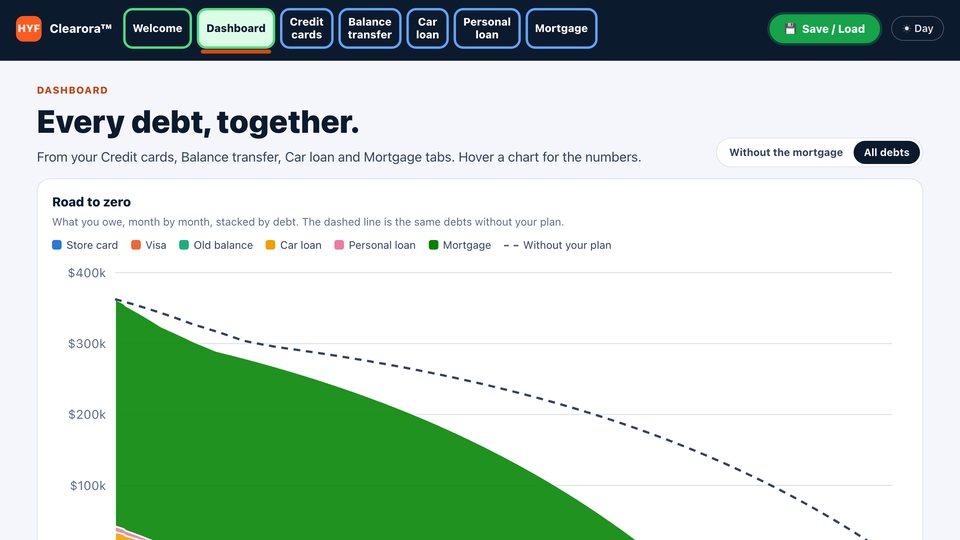
With a single card, the credit card payoff calculator shows your payoff date and what paying only the minimum costs. With one loan, the debt reduction calculator shows what an extra payment saves. To keep every debt in one plan from month to month, with both orders side by side and the payoff date of each debt, the Clearora™ Debt Payoff Dashboard does that: see how it works.
Sources: Consumer Financial Protection Bureau, "How to reduce your debt" (July 16, 2019, read October 29, 2026). The calculator's math is our own; the results are estimates from the numbers you enter.