Save $90,000 on Your Mortgage: The Down Payment Hack Nobody Talks About
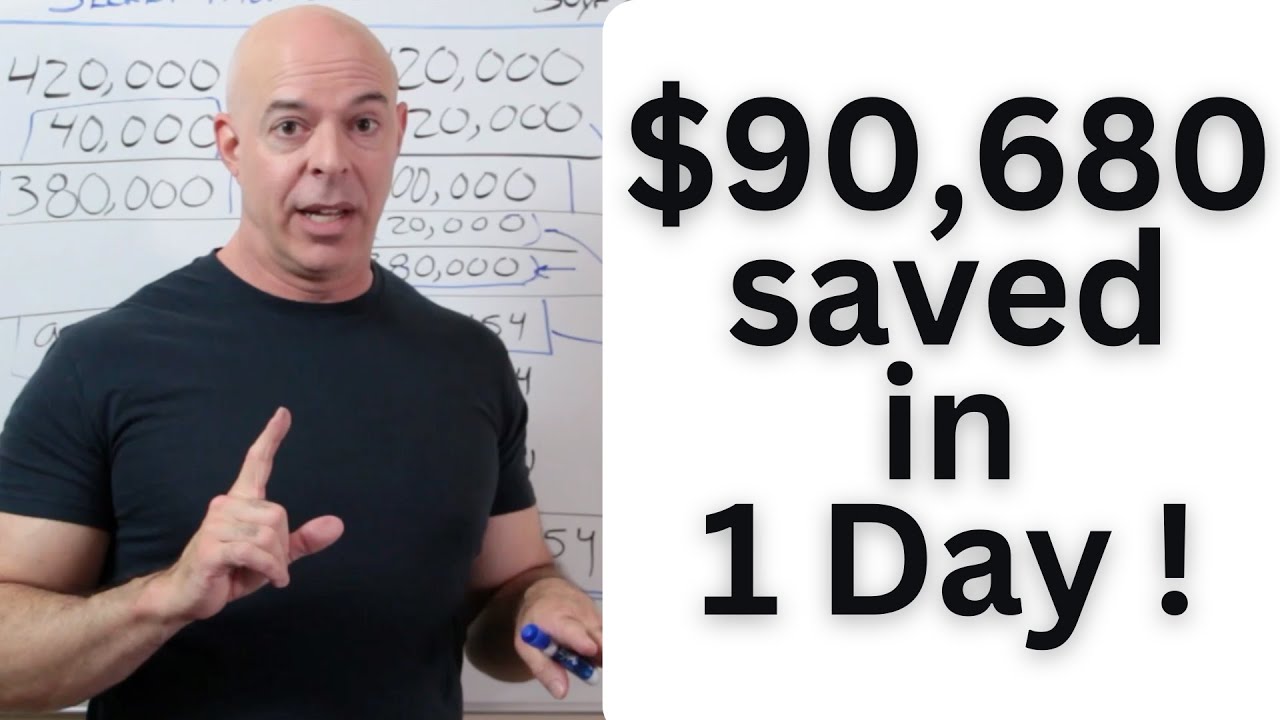
In this video I run the same $420,000 home purchase two different ways. Same house, same $40,000 of cash, same 7% 30-year mortgage, but one version costs about $90,000 more than the other. The only difference is how the home mortgage down payment gets split: all of it at closing, or half at closing and half sent in as a principal payment a day or two later. When you hand the bank your money changes the total.
It sounds like it shouldn't matter. I ran it through a mortgage calculator over and over because I didn't believe it either. Here's exactly what happens.
What you'll learn
- Why putting your full down payment at closing isn't always the cheapest move
- The two-option comparison: $40,000 down vs. $20,000 down plus a $20,000 principal payment
- How a bigger loan can end up costing you less in total
- Where the roughly $90,000 in savings actually comes from
- How this connects to velocity banking and doing it more than once
The setup: one house, two ways to pay
I used round numbers on purpose. It's June 2024, the median U.S. home price is around $420,000, and a 30-year mortgage is sitting near 7%. You've got about 10% to put down, so let's call it $40,000 in cash. Principal and interest only — I'm keeping taxes and insurance out of it so the math stays clean.
Option 1: the normal way
You walk into closing, hand over all $40,000, and walk out with a $380,000 mortgage. The payment is $2,528 a month. Over 360 months you pay $910,134 total, of which $530,134 is interest. Add the $40,000 you put down and your all-in cost is $950,134.
That's what almost everybody does. Nobody tells you there's another option — not the banker, not the lender.
Option 2: hold half of it back
Same $420,000 house. But this time you only bring $20,000 to closing. You walk out with a $400,000 mortgage and a payment of $2,661 a month — more than Option 1, because the loan is bigger. And you've still got $20,000 in your pocket.
A day or two later — or honestly, later down the road, this isn't only for brand new mortgages — you send that $20,000 in as a principal payment. It goes straight to principal, so now you owe $380,000, the exact same balance as Option 1.
Over the life of the loan you pay $819,454 in payments. Add the $20,000 at closing and the $20,000 principal payment and your all-in cost is about $859,454.
The total saved: about $90,000
Option 1: roughly $950,000 all in. Option 2: roughly $860,000 all in. You bought the same house with the same $40,000 of cash and saved around $90,000 — just by applying the money in a different order.
Here's the honest reason it works, and it's worth understanding: in Option 2, your required payment got locked in at $2,661 based on a $400,000 loan — but after that principal hit, you only owe $380,000. So every single month for the rest of the loan, you're paying about $133 more than the balance requires. That extra goes to principal, the loan dies years early, and the interest never has time to pile up. The bank sets you up with a higher payment, and you keep it.
Doing it again and again
This is close cousin to velocity banking, and that's where it gets interesting. If you can repeat the principal-knockdown move using a line of credit and your monthly cash flow, the savings stack — not $90,000 but $180,000 and up, depending on how many times you run the cycle.
Key steps
- Figure out your total available cash for the down payment.
- Decide what portion you'll actually bring to closing — and hold the rest back in cash.
- Close on the larger loan and accept the slightly higher monthly payment.
- Within a day or two, send the held-back cash in as a principal-only payment.
- Keep making the original, higher payment every month — never ask the lender to recast it lower.
- Run your own numbers in the Mortgage Calculator with Savings Calculation before you commit to anything.
FAQ
Does this only work on a brand new mortgage?
No. I show it as a day-one move because that's the cleanest illustration, but a lump-sum principal payment down the road works on the same principle. The key is that the payment amount doesn't drop when the balance does. If you're already in a mortgage, see how to pay off your mortgage early without wrecking your monthly budget.
Should I do this if I have credit card debt?
That's a different math problem. Card interest usually runs far above mortgage rates, so cash going to a 7% mortgage instead of a 20%+ card is rarely the better trade. Run it with the Credit Card Payoff Calculator first, and look at the real math on paying off credit cards fast.
What's the catch with a smaller down payment?
A bigger loan means a bigger payment and a higher loan-to-value ratio, which can affect what the lender requires of you. Your payment also has to fit your budget every month, not just on paper. Make sure the higher number is one you can live with before you choose this route — and if you're weighing a purchase at all, start with buying a house while in debt.
What mortgage down payment did you use in the example?
I used round numbers from June 2024: a $420,000 home, which was around the median U.S. price, a 30-year mortgage near 7%, and about 10% down, so $40,000 in cash. I kept taxes and insurance out so the math stays clean. Putting all $40,000 down at closing leaves a $380,000 loan at $2,528 a month.
Why does a bigger mortgage end up costing less in total?
In Option 2 the required payment gets locked in at $2,661 based on a $400,000 loan. After the $20,000 principal payment you only owe $380,000, so every month you pay about $133 more than that balance requires. The extra goes to principal, the loan ends years early, and the interest never has time to pile up. In the video I keep the original payment and never ask the lender to recast it lower.
The step-by-step written version, with a worked example.