Extra Principal Payment on a Mortgage: The Real Math on Saving $90,000
Most people think a mortgage is a fixed thing. You sign the papers, you get a payment, and for 30 years that's your life. But there's one lever on a mortgage that almost nobody pulls, and it's worth more money than any refinance you'll ever do: an extra principal payment, made early, while keeping your payment the same.
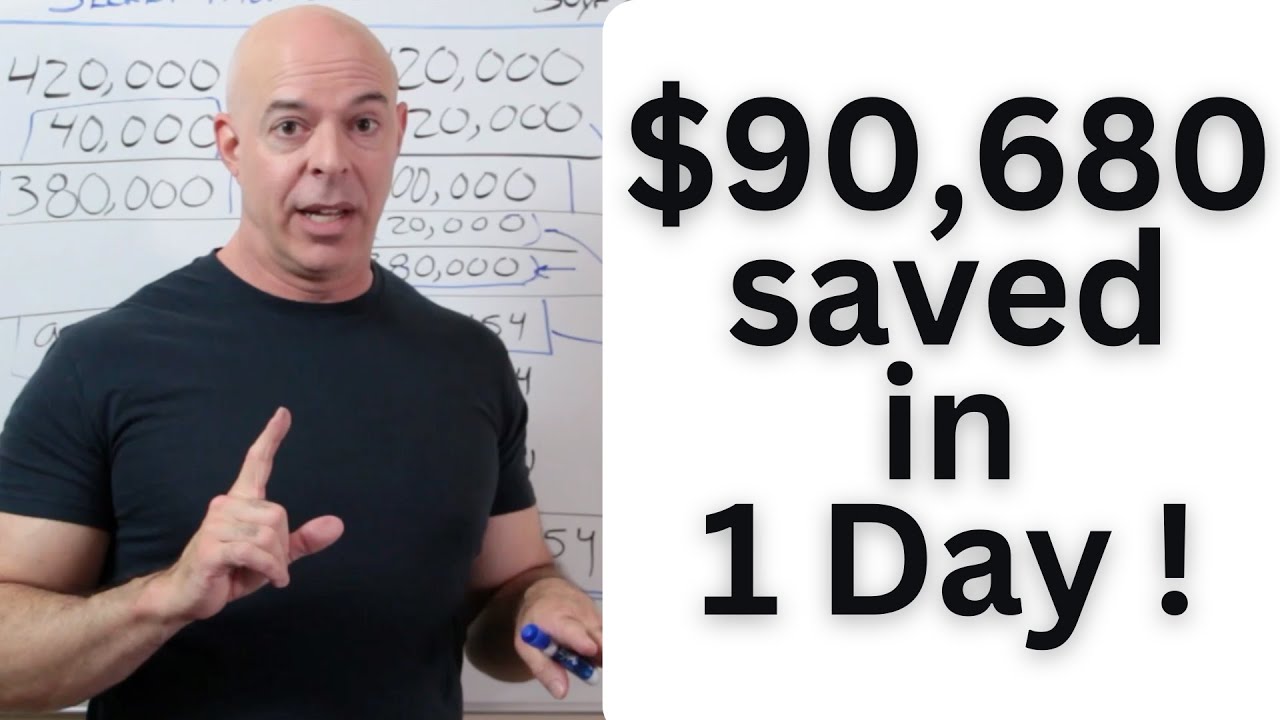
Brian walks through it on video.
I want to walk you through the math with round numbers, because when you see it side by side it stops feeling like a trick and starts feeling obvious.
Why an extra principal payment is so powerful
Interest on a mortgage is calculated on what you currently owe. Not on what you borrowed — on what you owe today. So every dollar of principal you knock off early removes 30 years of future interest charges on that dollar.
That's half the story. The other half is the payment itself. Your monthly payment was calculated when the loan was written. If you cut the balance but keep paying the same amount, you're now overpaying every single month — and all of that overage goes to principal. The loan collapses years earlier than the schedule says.
Put those two things together and you get numbers that look like typos.
A worked example: $420,000 house, two ways
Let's use a $420,000 home, a 30-year mortgage at 7%, and $40,000 in cash available for a down payment. Principal and interest only — no taxes or insurance, so the comparison stays clean.
Option 1: put all $40,000 down
- Down payment: $40,000
- Loan: $380,000
- Payment: $2,528/month
- Total paid over 360 months: $910,134 (including $530,134 in interest)
- All-in cost: $950,134
This is what nearly everyone does. Nothing wrong with it — it's just not the cheapest version.
Option 2: put $20,000 down, then pay $20,000 to principal
- Down payment at closing: $20,000
- Loan: $400,000
- Payment: $2,661/month
- A day or two later: $20,000 principal-only payment → balance drops to $380,000
- Total paid in payments: $819,454
- All-in cost: about $859,454 ($819,454 + $20,000 down + $20,000 principal payment)
The difference
| Option 1 | Option 2 | |
|---|---|---|
| Cash used | $40,000 | $40,000 |
| Balance after a few days | $380,000 | $380,000 |
| Monthly payment | $2,528 | $2,661 |
| All-in cost | $950,134 | ~$859,454 |
Same house. Same cash. Same balance after the dust settles. Roughly $90,000 difference.
Where the $90,000 actually comes from
This is the part I want you to really get, because if you understand the mechanism you can use it in a dozen other situations.
In Option 2, the bank wrote your payment against a $400,000 loan: $2,661. Then you knocked the balance down to $380,000. But the bank doesn't lower your payment — a mortgage payment doesn't automatically shrink when your balance shrinks. So you're now paying about $133 a month more than a $380,000 loan requires.
That $133 goes 100% to principal, every month, for the life of the loan. The balance falls faster, which means less interest accrues, which means even more of the next payment goes to principal. It compounds in your favor. The loan finishes years ahead of the 360-month schedule — and those missing years are almost pure interest you never pay.
Option 1 is actually the same loan with a lower required payment. Lower payment, longer loan, more interest. That's it. There's no magic, just arithmetic the lender never walks you through.
You don't need to be at closing to use this
The day-one version makes the clearest illustration, but the principle works whenever you can put a lump sum against principal and keep your payment unchanged. A tax refund, a bonus, a side-hustle quarter, money from selling something you don't use — any of it, sent as a principal-only payment, buys you the same effect at a smaller scale.
Two rules make or break it:
- Mark the payment "principal only." Otherwise some servicers apply it to your next payment or park it in escrow, which does almost nothing for you.
- Don't let the payment get recast lower. Some lenders will happily re-amortize your loan to a smaller payment after a big principal hit. That feels good and quietly throws away most of the savings. Keep the higher payment.
Run your own version in the Mortgage Calculator with Savings Calculation with your real balance, rate and term. Plug in a lump sum and see what it does to the finish date. That one number is usually what gets people to actually do it.
When you should NOT do this
I'm not going to tell you to throw cash at a 7% mortgage no matter what. Here's the order that actually makes sense for most people:
1. Credit card debt comes first
If you're carrying card balances in the high teens or twenties, every dollar there is worth two or three dollars sent to a mortgage. Kill that first. The Credit Card Payoff Calculator will show you exactly what a lump sum does on a card, and this breakdown on lump sum payments walks through it.
2. A basic cash cushion comes second
Money sent to a mortgage is gone — you can't get it back when the transmission dies. Don't hand the bank your last dollar to save interest and then end up putting a $3,000 repair on a 24% card. That trade loses. See how much emergency fund you really need while paying off debt.
3. A smaller down payment has its own costs
Putting less down means a bigger loan, a bigger required payment, and a higher loan-to-value ratio, which can change what your lender requires of you. The higher payment has to fit your actual monthly budget — not a spreadsheet version of your budget. If the number scares you, don't do it.
How to stack this: the velocity angle
Once you see why the mechanism works, the natural next question is: can I do it more than once? That's the idea behind velocity banking — using a line of credit and your monthly cash flow to repeatedly slam principal down, then rebuild the line, then do it again. Done repeatedly, savings in the $180,000 range and up are possible on a mortgage of this size, depending on how many cycles you run.
It also takes discipline and real cash flow, and it's not free — you're borrowing to do it. I've run the same question on car loans in car loan velocity banking: does borrowing at a higher rate actually save money? and the honest answer there is "it depends on the numbers." Same here. Run it before you run it.
Bottom line
An extra principal payment made early, with your monthly payment left alone, is one of the highest-return moves available to a regular person with a mortgage. In our $420,000 example, shifting $20,000 from "down payment at closing" to "principal payment two days later" saved about $90,000 over the life of the loan — using the exact same cash.
Handle your high-interest debt first, keep a cushion, then look at your mortgage with fresh eyes. And if you're not sure what order to attack things in, start with how to make a debt payoff plan that actually works or browse all the free calculators and let the numbers decide for you.