Short answer: your debt-to-income ratio (DTI) is all your monthly debt payments divided by your gross monthly income, the pay before taxes. $2,000 of payments on $6,000 of income is 33%. A CFPB budgeting worksheet offers general benchmarks of 36% or less for homeowners' total debt payments and 15% to 20% or less for renters' non-rent debt payments. These are budgeting guidelines, not universal lending requirements. Actual underwriting limits and counted expenses vary by lender and loan program. Type your numbers below to see yours and what it would take to bring it down.
Work out your debt-to-income ratio
Use the monthly payments on your statements, not the balances. Leave a box empty if it does not apply. Results update as you type.
Bring the ratio down with a plan
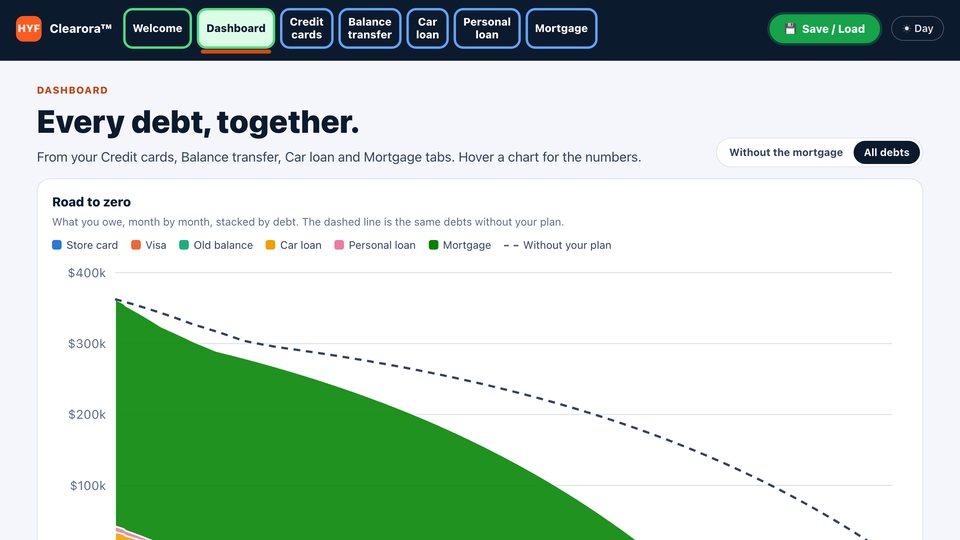
The ratio falls each time a debt is paid off. The Clearora™ Debt Payoff Dashboard puts every debt in one plan, shows the month each one is paid off, and saves your plan to a file so you can load it again next month.
See how Clearora works →What the debt-to-income ratio measures
The Consumer Financial Protection Bureau defines it in one line: "Your debt-to-income ratio (DTI) is all your monthly debt payments divided by your gross monthly income." Gross income is what you earn before taxes and other deductions come out of your paycheck, so it is a bigger number than what lands in your bank account. The CFPB's own example adds a $1,500 mortgage, a $100 car loan and $400 of other debts, $2,000 in all, and divides by $6,000 of gross monthly income: 33 percent.
The CFPB's debt-to-income tool puts it more plainly: at 36 percent, 36 cents of every dollar you earn goes to debt, and 64 cents is left for everything else. That is why lenders look at it. A high ratio tells them a new payment may not fit, and the CFPB notes it can affect your ability to get more credit.
What counts and what does not
| Counted as a debt payment | Usually not counted |
|---|---|
| Mortgage payment. The CFPB worksheet's mortgage ratio uses principal and interest only; for a mortgage application, Fannie Mae counts the whole housing payment, including property taxes, insurance and association dues | Rent, in the CFPB's renter guideline (a lender looking at a new mortgage counts the new housing payment) |
| Car loans and leases, student loans, personal loans | Groceries, utilities, phone, gas, subscriptions |
| The minimum payment due on each credit card, not the balance | Insurance you pay on its own, such as health or car insurance |
| Child support or alimony you pay, and the payment on any new loan you are applying for | Savings and retirement contributions |
Each lender has its own list, so read the application. If your income goes up and down, the CFPB suggests using a typical month and estimating low rather than high.
The guidelines, from the sources
There is no single number every lender uses. The CFPB's ask page says it directly: "Different loan products and lenders will have different DTI limits." Two kinds of numbers are published, and they are not the same thing: budgeting benchmarks from a CFPB worksheet, and the underwriting limits a lender or loan program applies. These are the ones we could find:
- CFPB budgeting benchmark for homeowners: all debt payments, the mortgage included, at 36 percent of gross income or less. For the mortgage payment on its own (principal and interest), 28 to 35 percent. The same worksheet adds that some lenders will go up to 43 percent or higher.
- CFPB budgeting benchmark for renters: debt payments at 15 to 20 percent of gross income or less, with rent left out of the ratio.
- Fannie Mae (an underwriting rule, for the mortgages it buys): a maximum total ratio of 36 percent for loans underwritten by hand, up to 45 percent when the borrower meets its credit score and reserve requirements, and up to 50 percent for loans run through its automated system, Desktop Underwriter. Its ratio counts the full housing payment (principal, interest, property taxes, insurance and association dues) and the lender's own list of debts and qualifying income.
The calculator shows the CFPB benchmark that fits you: the 36 percent line if you own, the 15 to 20 percent line on your debts without rent if you rent. It also shows your total ratio with housing included, because a mortgage lender looks at a total ratio. It is a simplified budgeting ratio from the numbers you type in, not a lender's underwriting DTI.
A worked example
The calculator opens with $6,000 of gross income a month, a $1,500 mortgage payment, a $350 car loan, $200 of student loans and $150 of credit card minimums. That is $2,200 of payments, and $2,200 divided by $6,000 is 36.7 percent. The mortgage alone is 25 percent of income, below the 28 to 35 percent benchmark for the mortgage on its own, but the total is just over 36.
To get back to 36 percent, the payments would have to fall by $40 a month ($6,000 times 0.36 is $2,160), or the income would have to rise to about $6,111. To reach 28 percent, the payments would have to fall by $520. Paying off the $150 of card minimums and the $350 car loan would do almost all of that, which is why paying down debt is the most direct way to move the ratio.
How to lower your debt-to-income ratio
Only two numbers move it: the payments on top and the income below. On the payment side:
- Pay a debt off completely. A paid-off loan drops its whole payment from the ratio. Small balances go fastest, which is the idea behind the debt snowball calculator. The debt avalanche calculator orders the same debts by interest rate instead, and the snowball vs avalanche calculator shows both side by side.
- Pay card balances down. Card minimums are usually set from the balance, so a lower balance usually means a lower minimum. The credit card payoff calculator shows how a minimum is worked out.
- Hold off on new debt before you apply for a mortgage or a loan. A new car payment counts the month it starts.
- Be careful with longer terms. Stretching a loan over more years lowers the payment, and so the ratio, but the CFPB warns that a lower payment over a longer time can cost more overall. The debt consolidation calculator shows both the payment and the total cost of a consolidation loan before you sign.
To find the money for extra payments, start from your take-home pay with the budget calculator: it shows what is left each month after needs, minimums, wants and savings.
If a lender turned you down
A high ratio can be the reason, but it is not the only one a lender looks at. Ask the lender which reason applied. Then work the number down for a few months, starting with the debts that drop out of the ratio soonest, and run the calculator again before you reapply. A ratio is one number from one month; the plan that brings it down is the part that changes your situation.
Sources: Consumer Financial Protection Bureau, "What is a debt-to-income ratio?" (last reviewed August 28, 2023); CFPB Your Money, Your Goals "Debt-to-income calculator" tool (November 2018, in the toolkit updated April 24, 2026); Fannie Mae Selling Guide "B3-6-02, Debt-to-Income Ratios" (April 2, 2025) and "B3-6-03, Monthly Housing Expense for the Subject Property" (December 16, 2020); CFPB, "What do I need to know if I'm thinking about consolidating my credit card debt?". All read October 29, 2026. The calculator's arithmetic is our own; results are estimates from the numbers you enter, and every lender calculates its own ratio.